Search This Blog

Showing posts with label politics. Show all posts

Thursday, March 15, 2012

ME2 | Life, Death, and Everything Inbetween

It's funny how simple and complex life is. It's a paradox that will continue to sustain itself as long as humans exist. Time is a big part of it. Time and knowledge (or the lack thereof). For example, I was eating dinner, chatting with the family, and watching part of Harry Potter and the Sorcerer's Stone on TV as a rerun just moments before I started writing this. (Okay, I'll admit it. I'm multitasking. I'm still watching HP.) After I finish this, I'll probably continue watching the movie, read a book, and play Skyrim. Life goes on. It always does. This blog won't change the world. My posting about the intricacies of video games may be interesting - I certainly think it is - but of the seven billion people on this planet, maybe a dozen will read it. Perhaps I'm being pessimistic. Maybe the right people will come by this blog, find it unique enough to make note of and share with others, and it will take off, making me an Internet sensation overnight. That's just one more facet of life: ambiguity. The unknown is as fascinating as it is terrifying. How does technology fit into all this? Well, it enhances the experience of life. Look at augmented reality. Look at the phenomenon of touch screens. Look at the explosion of 3D cinema (and printing, for that matter). It literally tries to make life better, or at least more interesting. To a certain degree, it does.


And now, for something completely different. (Not really. It's quite relevant.)


Samara Loyalty


There are so many parallels between each character within the game, it's almost comical. Here, Samara reveals that the asari have a rare genetic flaw that occurs only within a line of purebloods. (How convenient that I'm watching Harry Potter while discussing this.) This flaw creates what the asari call the Ardat-Yakshi, which means "demon of the night winds". Basically, these asari are sex-crazed sociopathic killers. The condition affects their nervous systems and makes it so that when they mate with another, they take over the other's mind and essence of being, destroying their brain, killing their bodies, and sucking their soul. (So, they're kind of like Dementors.) Through this, they gain power and become more obsessive. Freaky, no? Samara's daughters are some of the few lethal breeds of Ardat-Yakshi, which can reasonably create some tension in the family. Two of the daughters have chosen to spend their lives in isolation, preventing any danger to others or themselves. The third, however, embraced the obsession. This daughter, Morinth, has been traveling the galaxy, killing with her sexual prowess and gaining a boatload of power through it. Samara's mission - which is something she's been trying to do for hundreds of years - is to find Morinth and kill her. A mother has to kill her own daughter to save lives, as part of her moral and lawful obligation. Yikes. But that's exactly what happens. (I know that there's a way to kill Samara and bring Morinth onto your squad instead, but for some reason I didn't have that option in this playthrough. Oh well.) It was extremely creepy to purposefully step into a club, catch Morinth's attention, and have her take me back to her place thinking that I was just another great catch. Thankfully, Samara was there the whole time, watching my back. Still, it was unnerving. It's kind of like those movies or TV shows where the civilian wears a wire with microphone under their shirt to catch bad guys, constantly fearing getting caught. I would never willingly sign up to be bait for a homicidal sex addict. (FemShep has balls of steel for that.) Samara not only wishes to kill her to uphold the code, but also for a surprisingly personal reason: she wants redemption. She sees herself as the guilty factor of Morinth's life choices because Samara gave birth to such a monster. The genetic mutation is directly linked to pureblood lines. It wasn't anybody's fault. Science creates natural anomalies. Technically, I myself am a scientific anomaly as an identical twin. (Weird.) It brings up an interesting psychological factor of the parental obligations to a child. To some, children will always be under the responsibility of the parent, no matter the age. Family has a particular bond for those within it. Even mafia movies can agree to that. I can't help but think of the Hulk and Frankenstein and other classical narratives that depict monsters. The correlations are obvious.


A quick quote that Samara uses in a letter to her daughters (the non-crazy ones): "Time is a weak salve for a fresh wound." Powerful statement.


Thane 


I like this character. He's an interesting guy who, like Mordin, is very thoughtful and philosophical. He bears great respect for his beliefs and bases his life upon them. But to complicate this, he's an assassin, and a ridiculously skilled one at that. It certifiably resonates with me due to my history with the Assassin's Creed franchise. According to their creed (nothing is true, everything is permitted being the tagline of it), they kill only those who cause harm and destruction to the innocent and wreak havoc on society as a whole. Their targets are Templars. If they can avoid unnecessary death, they will, and if they can save the innocent, they will. After every kill, they close the target's eyes and mutter, Requiescat in pace under their lips (which means "rest in peace" in Latin, for those who are unaware), sending even those who they feel ill will toward to a better place. Thane does this as well, though the prayers are for himself. Killing is what he was literally raised to do. He does it because he's paid and told to do it. His philosophy separates the soul from the body; they are two entities acting in one form. Those who create the contract for the hit are the true killers, according to Thane. They are the killers, and Thane is simply the tool they use to do it. As he mentions in the loyalty mission (which I'll get to in a second): "If you kill a man with your gun, do you hold the gun responsible?" To give him even greater character depth, we learn right from the get-go that Thane is dying. He has a cancerous-like disease called Kepral's Syndrome. Like cancer, it is caused by the environment and has no discernible cure. This gives Thane an even greater motivation to do dangerous missions. He knows he's doomed to die in the not-so-distant future anyway, and would prefer to eliminate as many bad guys as he can to leave the galaxy a little bit brighter before he passes on. For his loyalty mission, we find another issue with family. Thane has discovered that his son is entering the assassination business, but perhaps isn't doing it well or for the right reasons. (He also lacks the intensive childhood training.) He steps in to spare his son from the life that he lives. He bears guilt for the loss of his wife, his son's mother. While he was away on business (cuz it's totally normal to have your dad be an elite assassin), enemies attacked and murdered her. She was his weakness, a force that "awakened" him, and that flame was put out when he thought things were safely taken care of. Thane doesn't have a close relationship with his son because he was away so often, and because his son is angry with him for her death. They try to work things out (I think it goes better as a Paragon character, but I can't remember right now). It's an unfortunate situation.


My sister always makes fun of his appearance, saying that he looks like a frog or gecko.  He does have an amphibian-like quality to him, gills included, but I see his character more than his appearance.
I jotted down a couple of things here. The first is that Thane claims that "those who are truly dangerous" don't fit the physical profile. Those who pose the greatest threat are those who do so in secret. You can even go as far as considering this on a figurative level. Technology poses a great threat, yet we all blindly rely on it. A virus strikes from within the software, destroying the work we've been so diligently working on for several hours. Evil and dangerous, yet trusted and given the benefit of the doubt. Technical images seem to be infallible, perfect, ideal, when they are actually deceptively flawed.


He has perfect recollection of memory in what he calls "solipsism". The definition of this is a philosophical theory where "only the self exists, or can be proved to exist". Deep stuff. The memory feels very real, even though it is more like a mental leap back in time. Don't mistake this as something like Source Code where Thane can go back and change it or meander about it that area of space and time. He simply recalls the memory with flawless clarity. I thought of D. J. MacHale's invention, Lifelight, where people willingly invest in sitting in a machine that lets their mind wander in a land of pure fantasy. Thane mentions that sometimes, drell (his species) get lost in their memories and continue to live in them as though it was real. (Now that bit is a little more like Source Code.) To be able to have any contact with something so seemingly perfect is a difficult temptation to ignore.


I also had to make note of that fact that Thane referenced the work of Thomas Hobbes and his theory of the social contract and what happens when government is removed from the equation (war). As someone who has studied political science and ideologies (though not extensively), I found that particularly noteworthy. Awesomesauce. Furthermore, he claims that "entropy always wins". There will always be a decline into chaos, a time for war amongst civilizations, as history constantly repeats itself.


The scenario of being trained to kill as a child reminds me of the Kony 2012 movement. And it wheels me back to free will again. And the potential for indoctrination. If they don't know any better, how are they to judge their actions as bad? They don't know it's wrong because the society they were raised in said that everything they were doing was the norm. Thane is fully aware of his actions and what he does. That separates him from this. He's very intelligent and is fully aware of it all. His beliefs are so intrinsic to who he is and why he does what he does, though. In some ways, he is also a warrior monk like Samara.


Mordin


Had to make a quick note of something he said in a dialogue scene. He recognizes that it's very difficult to fathom an entire galaxy of living beings. There are seven billion people living on Earth currently, but can you actually sit there and put a face, personality, background, and empathetic connection to every single one? No, you can't. Seven billion is just a number. To more appropriately wrap your head around it, picture a personal connection - in Mordin's case, a nephew - to find a reason to fight. Imagine that all of those seven billion people are just like your nephew, and suddenly it becomes a planet worth fighting for. Life is just a matter of perception, as the show Fringe has claimed. (Speaking of intelligence and sci-fi and everything that makes Mass Effect epic, Fringe is a phenomenal example of some of the same stuff I've discussed here in television form. Not in the same way, obviously, but it discusses advancement of science and what it could look like or how it could affect humanity. I love it.)


Liara and the Shadow Broker


To spare you from further redundancy, I will only touch on this part of the game. This is very much relatable to the Illusive Man and the idea of secrecy, money, reputation, and influence being a major power play in the galaxy. The Shadow Broker is like the long-lost brother of the Illusive Man, really. The main difference is that the Illusive Man's goal is to preserve and ascend the order of humanity. The Shadow Broker, in a narcissistic way, uses his/her power to maintain balance and order in the galaxy through the means of constant monitoring, bribery, trickery, and so forth. (This is actually a DLC I purchased, so isn't technically part of the main game, but it's kind of awesome and helps out a lot in regards to Renegade points, finances, and resources.) Liara's mission is to take down the Shadow Broker, who kidnapped her friend who had helped rescue FemShep's destroyed, dead body at some point after the intro scene where Shep gets blasted. (It's quite a revelation that Liara saved FemShep, I thought.) She'll do anything to get him back, even if it means taking down one of the most impossible characters to reach. But she does it. She's spent two years and a great deal of effort tracking him down and, with the help of FemShep's latest ally (the double-edged sword Cerberus), they locate him and take him down. The neat thing is that the Shadow Broker is a title, a mask for any creature who takes the role for his or herself. There have been many Shadow Brokers over time, but no one knows this. They all assume that the Shadow Broker is immoral, a mysterious figure that has been in power for hundreds of years. If you've ever seen The Princess Bride, you might understand this a bit better by relating the Shadow Broker to the Dread Pirate Roberts. Roberts had died long ago but secretly replaced a trusted crew member to take on the role instead. This happened several times, Wesley being included in this chain of events (and possibly the famed Inigo Montoya as well). For this reason, it's also like Batman. "As a symbol, I can be everlasting." Just as the Internet and technical images immortalize figures, phrases, etc., symbols do the same in a more primitive medium. The criminals of Gotham don't fear a man in a cape, or Bruce Wayne. They fear Batman. What makes this interesting is that Liara, after defeating the current Shadow Broker (a creepy-looking alien called a yahg, as pictured below), takes on the role of the Shadow Broker. What makes it more interesting is the way at which she does it. Her philosophy is to be a good influence on the system. Rather than base everything on corruption, she wishes to "use this power for good" and try to make the galaxy a better place with her now endless supply of resources and connections. In one quick decision, she suddenly has more control than any single being in the entire galaxy. Woah, Bessie.


The not-so-adorable yahg, a rare and thought to be extinct alien race. This particular one became the Shadow Broker for some time until Liara comes along. Also, he reminds me a lot of a character you might see in Zelda, like those leafy guys in Wind Waker. 
Liara now controls the various connections she has throughout the galaxy and reboots the system, starting from scratch to initiate a less corrupt Shadow Broker facility.


One other quick reference to The Princess Bride is the torture machine Liara's friend is hooked up to. The Pit of Despair, anyone? That chair is a pretty ingenious design, though, that must have taken much research and money. It connects to the victim's vitals and nervous system to sustain life, but also electrocutes with that same connection. An eternal chain of torture.


Tali and the Migrant Fleet


The connection between parent and child - creator and created - is another recurring theme of the series. With the quarians and the geth, it's still maker and creation but on a synthetic level. Is it slaves overthrowing their masters, or children rebelling against their parents? The geth kicked the quarians off of their homeworld some time ago when they essentially went on strike to have free will. (ME3 goes into this and fleshes it out in a great way. I can't wait to experience it for myself.) The technological robots who were supposed to be devoid of personal thought seized the day and did what any lower, controlled race would: they rebelled. The twist is that they're tech. Because of that, we all assume that they're evil beasts trying to take over the world, but are they really? (Skip to the Legion section for more on this.)


Recruiting Tali means battling through a giant field of geth. Not so fun. They're everywhere, constantly firing everything they have at you. Her purpose for being on this ridiculous planet is to study a dying sun (being in any direct sunlight attacks your body and would kill you were it not for the armor and shields protecting you). She believes that dark energy is involved - a seriously foreboding notion, since the only known connection to dark energy in this game universe is the Reapers.


You never see a quarian out of their suits or without those helmet mask things on. What lies behind it all?
Then there's the loyalty mission with Tali. She is accused of treason. She has been sending geth parts to her father for study. She claims they were inactive and completely safe to use. A recent attack on the ship where her father was working suggests otherwise, since geth were the obvious culprits to destroy the base. This mission delves into politics as Tali is essentially subpoenaed to a trial with the Migrant Fleet (the center of all quarian civilization). They wish to exile her for putting their race in harm's way. Tali didn't do it, of course, and I go on a little mission through the destroyed ship to prove it. As it turns out, her father was the wrong-doer. He took the inactive parts Tali sent and made them active, attempting to create a weapon that could destroy all geth once and for all. Tali's father cared for her, but showed his appreciation and love poorly; he was always gone, working, never giving his family the time of day. (It's like workaholic parents who are never home and dedicate themselves to their job. The parent believes he or she is doing the right thing and helping others, but there is a deep psychological effect on the child because of this neglect.) The trial itself is very similar to America's jury system, but less formal. It's like a bad family meeting over Thanksgiving dinner. The politics themselves are interesting to consider. They don't believe in prisons or execution. Instead, they sentence the accused (if proven guilty) to work off their crime somehow, or be exiled from the Migrant Fleet completely, never to return again. The exiled can send their children to the Migrant Fleet, however, so their descendants won't be punished for their wrongdoing. It's an interesting solution to punishment.


I noted that actions speak loudly, as does precedence. FemShep argues on Tali's behalf that she helped save the entire galaxy from the Reapers two years ago, a proven fact that stands to her name, and that it can't be ignored or pushed aside. She put her life in jeopardy for all galactic life and would do nothing to harm her own civilization. This happens as either a Renegade or Paragon Shepard, though the manner at which the argument is given certainly changes. (I basically yelled at and scolded the judges.)


After some thought, I'm beginning to think that the quarian race isn't purely organic. The suits they wear are high-tech and very different from anything else in the game. The quarians are easily susceptible to disease, which makes me think they're a more interesting species than some give them credit for. Perhaps they're like the Reapers - a combination of synthetic and organic life. I hope to learn more about them.


Legion


I had to stop playing right after I brought Legion on board, so I didn't actually have the time to converse with his character. Pity, since speaking to him was something I found great interest in. Since I didn't play the section with him in it, I'll at least provide the clips of cutscenes for his character. Very interesting to watch. Technology at a peak of advancement. Cool. Inspiring. Dangerous.


The bottom line is that he represents a form of technology that can actually converse on its own, an AI that acts according to its own functioning. While it is still based on processors, wiring, and data, it has assimilated itself over time to create its own thoughts. There is no individual personality for each geth, but there is a personality and belief system for all geth as a whole. I'm genuinely mind-blown by this.


And So It Goes...


The ending of the game doesn't really give me much to talk about that I haven't already mentioned. (Well, there is a bit I could talk about, but it's more about ME3 than ME2 so I'm refraining.) The team gathers resources and such to be able to travel through the Omega 4 relay (ol' reliable Normandy). A creepy human-like version of a Reaper is being created by the Collectors, which is the reason for the huge amount of abductions of humans. FemShep and crew destroy the entire base of the Collectors, including the freaky human Reaper baby. As a Renegade, FemShep saves the data to provide to Cerberus for investigation and study; as a Paragon, FemShep would have destroyed it with everything else. Oh, and Cerberus is strongly hinted to have turned on you after you did your job - namely, the Illusive Man suggests this. No big surprise there, after everyone except Miranda in this game is warning you not to trust Cerberus and that they'll turn their back on you the moment you're no longer useful. This ending serves as a bridge to the final installment in the trilogy. The Collectors may be destroyed, but the Reapers are coming nevertheless, and they've set their gaze on Earth. Dun dun duuuuuuh!


Creepy human-looking Reaper baby. So glad that thing gets destroyed.
This video uses a male Shepard instead of FemShep, but it nevertheless represents the Renegade ending.


Gaming Segment (14+ Hours)


I didn't do all of this in one day. I could, of course, but not during college courses. I combined a few gaming segments together for the sake of completion. (4 + 3 + 2 + 4.5 + 1 = about 14.)


I'm a bit bummed that I didn't have the time to actually complete the game, but I'm also not. The ending is extremely frustrating, but not because the game is bad. It's frustrating because it's hard, which makes it a game worth playing. It also makes it time-consuming, which is something I couldn't afford to do when I had to study like mad for finals week. Thankfully, I know how it ends and the Internet is a useful resource to set things straight. If you're ever confused about anything I posted or simply want to know more about Mass Effect, the Internet is your friend. Check out the Mass Effect wiki for loads of details on it. I will likely play this game again, and maybe even as a Renegade, now that I know what it's like and what it takes. It isn't about being evil - it's about being logical to the point of putting the facts ahead of emotion.


And that's my final post. I hope you were able to take something away from this. I enjoyed it, and not just because I got to play a video game (although that's certainly nothing to complain about). I had already wanted to study the Mass Effect series, believe it or not, and this was the perfect opportunity. I'm pleased with the result. I've taken so much away from it. I don't think I'll ever look at a video game the same way again. As I go off for my much-needed vacation this weekend, I will likely continue my gaming with Skyrim or Assassin's Creed: Revelations, but I'll consider them differently than before. (You may think I'm just saying that, but I really will think about my games with a critical eye.) Thanks for reading! Feel free to post comments, and do refer to the video walkthrough on the right side of the page, if you get the chance. I may even continue this after the fact, just cuz I can.


Happy gaming!


~Mel

Saturday, March 3, 2012

ME2 | Politics, Realism, Technology, and You

Now that the basics are out of the way, I can use these blog posts to zoom in on characters, concepts, thematic elements, and more specific uses of technical images and augmented realities. In other words, I can start to dig beneath the surface and get to the good stuff.

Honor still matters, despite some seemingly dishonorable actions, to the Renegade FemShep. She is a soldier who will do her duty and follow orders (with the exception of exigent circumstances). That's a distinction that must be recognized: both Paragon and Renegade Shepard characters are heroes who do great deeds and impossible feats. It's the manner at which they go about it that changes, which alters pieces of the puzzle without completely changing the end result. FemShep still has to defeat the Collectors and stop the Reapers from killing everyone at the end of the day. I always assumed that the Paragon route was purely good and Renegade was purely evil, but it's quickly becoming clear to me that that is anything but true. 


Recruiting Mordin

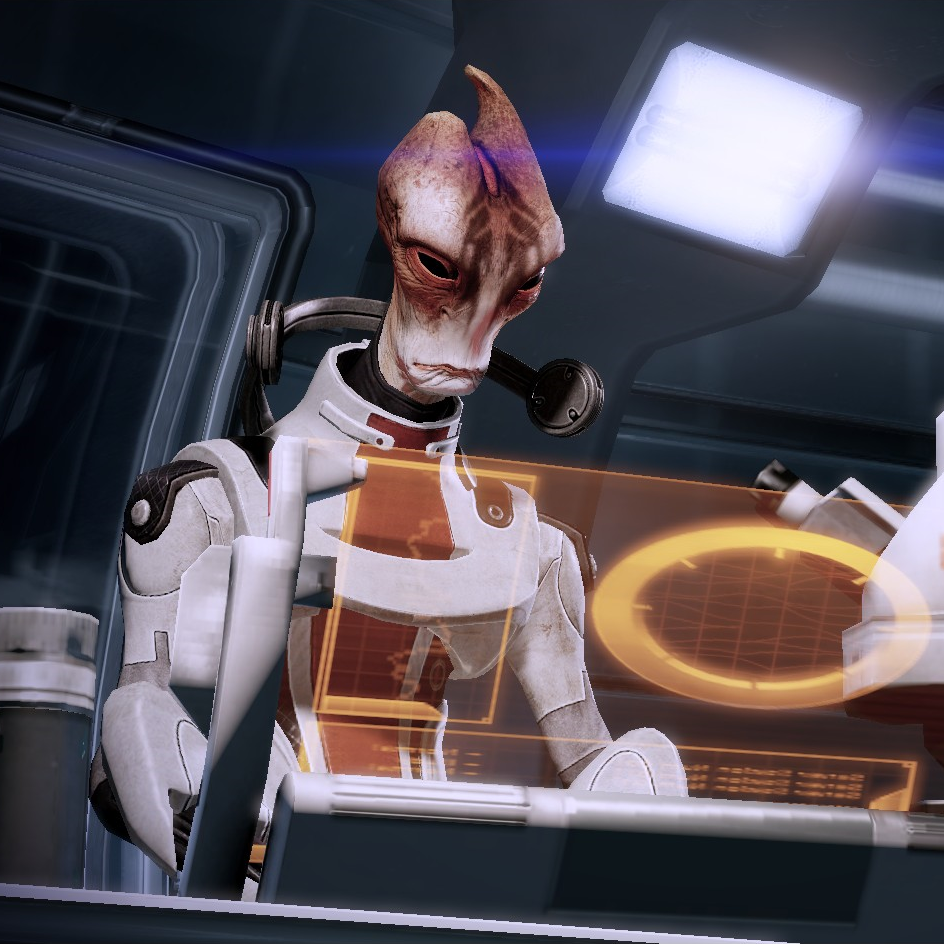
Mordin Solus, the brilliant salarian scientist, clarifies that the way to help people isn't black and white; rescuing someone innocent and killing someone dangerous can both be helpful in some way. He's an interesting character in that he's both a doctor and a soldier. He worked for the salarian Special Tasks Group (STG), a military organization that was known for its deliberate strategics as well as its ventures into espionage, reconnaissance, and assassination. When FemShep adds him to her team, he's working in a medical clinic on Omega, a civilization that thrives on crime and corruption. (It also happens to be built into a giant asteroid.) He built the clinic in the middle of a battle zone rampant with a deadly plague to help humans - a species that many aliens blame for the plague. He's a somewhat paradoxical character in that he's just as likely to save a life as he is to end it, and he's willing and able to see both sides. An interesting note that carries over to all characters in this game is that he seems to be an amphibian-like character who, at first glance, seems hard to adjust to. Thanks to technical images, not only does he exist, but we can understand him perfectly. A male human being, just like us, is providing the voice to this character. Had the game creators decided to give all non-humans strange, garbled sounds and provided us with on-screen subtitles instead, our reactions to these characters may have been quite different.


The Illusive Man and Cerberus

The Illusive Man, the mysterious leader of Cerberus, strikes me as an egotistical type who believes humans are worth protecting to a point of superiority over other species. At some point in the game, it's mentioned that he essentially represents the polar extremes of humanity - the best and the worst qualities of the human race as a whole. His name came from a little nickname the Systems Alliance gave him when he started rebelling and news reports came out about him and his actions; they couldn't find him or figure out who he was, so they dubbed him the "illusive man" and it stuck. He's more concerned about the end goal than the means at which he achieves it, which may explain why many view Cerberus as a terrorist group. He spent seemingly "unlimited resources" to bring FemShep back to life, and all because he thinks the future of humanity hinges on Shepard. (Effectively, he puts the pressure on FemShep of the entire galaxy. It's somewhat understandable, but not necessarily fair or right.) As FemShep goes on missions to recruit crew members and discover more about the Collectors, the Illusive Man is always watching and gathering intel. What makes him a somewhat evil character - a Renegade like FemShep - is that he's willing to keep things to himself and put people in harm's way if it means gathering necessary data; he purposefully sends FemShep and crew into a trap, but doesn't really care because he has confidence in Shepard's abilities and needed to seize the opportunity to find information that would have otherwise been impossible to get. Inhumane, but justifiable. This man is rich, powerful, and mysterious - a combo that's worth trembling at. What clinches it is his casual demeanor as he sits in his chair, smoking a cigarette, acting like the end of the world is just another movie he's watching on Netflix. He's playing god - a puppet master in a galaxy of gullible creatures. He isn't in the action himself, but his words, his contacts (no, not the eyeball kind, although his freakishly blue and likely technologically-altered eyes are quite alluring), his money, and his reputation get the job done. This reminds me of the Internet. Take MuggleNet, for example. It's a fansite for the Harry Potter series that was created several years ago by a big fan of the books, Emerson Spartz. He made it before it became hugely famous as a young kid. But when the series began to pick up, so did the site, and now it's a HUGE website with millions of followers - a go-to resource for HP fans everywhere across the globe. What society would call "nobody's" can become "somebody's" because of the Internet. There is power in words and influence, and we can use it at the touch of our fingertips. A good idea can take off if it passes through the right computer monitors.


The Citadel

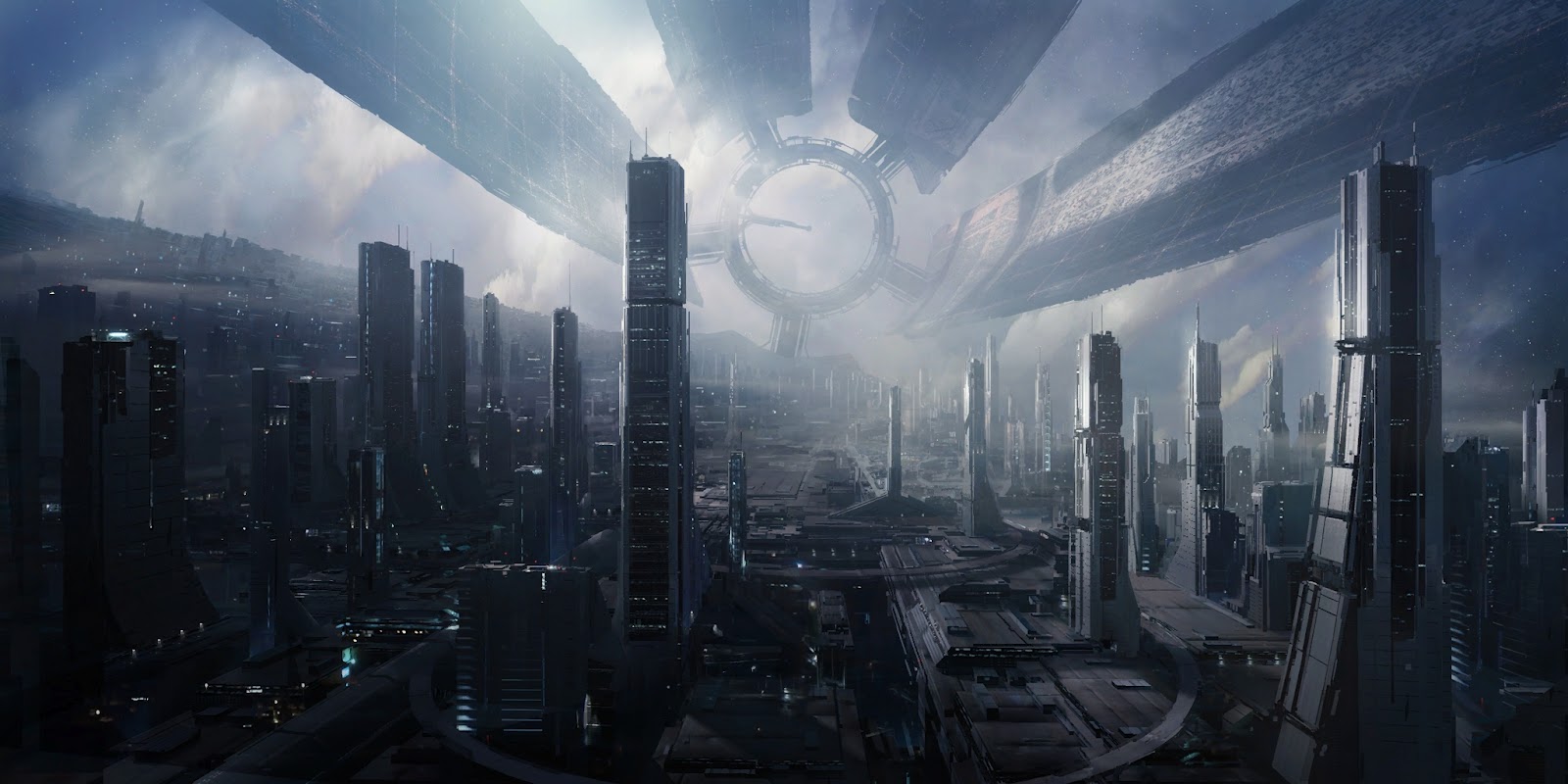
I could talk about the Citadel for days. It's such an impressive and beautiful thing. It represents the center of galactic stability and balance - the yin and yang of the known universe. All civilized alien races come to the Citadel; many live there in various wards, some of which are considered the slums where there are higher crime rates. The attack on the Citadel at the end of ME1 caused a lot of damage, but didn't destroy it. Efforts have been made to rebuild it, and much of it has been restored by the time FemShep revisits it. Here's one of my favorite images that shows the detail and massive size of it. There are five "wings", and there are large, apportioned wards on each wing. Every human on earth could live on the Citadel and might not even fill one wing. It's astronomically huge and astounding. 


The Presidium is the elite sector of the Citadel. It contains embassies for species across the galaxy - the political heart of space. Every alien race sends representatives to the Citadel to speak for their kind about their nations. They address the Council, a select group of leaders that make the ultimate decisions for everyone. In some ways, they could be viewed as a parliamentary government. The game series makes a statement about politicians and how corrupt and bureaucratic they are, but at the very least they're an efficient bunch that does get things done and reacts well to even the most dire situations. They even have an organized system for law enforcement: Citadel Security Services (C-Sec). It's volunteer-based (though each recruit must come well-recommended and either have a military background or demonstrate strong skills) and consists of a variety of species, just like the Citadel itself. After ME1, there are a lot more humans involved, and security is tightened to prevent infiltration (especially geth). I'll refrain from delving into the area of Spectres because it isn't relevant in ME2, but feel free to Google it and check it out for yourself. They're basically powerful Batman-like figures that do big, off-the-books missions for the Council. 

Presidium
C-Sec (Citadel Security Services)
Recruiting Jack

The environment on Purgatory - a massive floating prison - is hostile and dirty, certainly worse than our prisons now. Torture of inmates is frequent by both guards and other prisoners. Most - if not all - of these prisoners, however, are not mere white collar criminals. They've all committed multiple murders and done degrading, violent things to many beings. (Does that mean they deserve to be tortured? Not necessarily, but it increases the likelihood that less people will stop it.) This ship represents a possible future for prison systems when money and technology advance and we decide to "improve" on the government. The Warden seems okay with jettisoning individual crates of prisoners into space "as an example". Nice, dude. He also claims: "I do the hard things the government isn't willing to." Perhaps he feels that the Citadel has gone too soft on prisoners. He deals with some of the worst criminals in the galaxy. As for Jack herself - yeah, Jack's a girl - she's an interesting analysis of pure biotic energy. (I can delve into her character more later with her loyalty mission.) If I remember correctly, biotics stem from something similar to radiation poisoning. They were exposed to the chemical Element Zero, which humans hardly new anything about, and civilians were then tested with Element Zero and eventually displayed biotic powers. It's as though the idea came straight out of a comic book. I have a strong Fantastic Four/Hulk vibe from it. The introduction to the possibility of biotic energy was less than reputable, but the exploration of it afterward is pretty interesting. Jack didn't have such a good time with it, but she turned out to be one of the most - possibly THE most - powerful biotic in the galaxy. She swears a lot, has a ton of tattoos that represent her life (cults she joined, people she killed, things she destroyed ,etc.), doesn't trust anyone, and loathes Cerberus with a fiery passion. She's a loose canon, but a very powerful ally. I died once trying to save her in the game. 


Sidenote: I'm not quite sure why, but Purgatory reminds me of Ender's Game and the strange military-style ship that Ender is sent to. At least Purgatory has gravity, though.

Recruiting Zaeed/Zaeed Loyalty Mission

I didn't jot down much for notes with him, but he's an interesting character. He used to lead the Blue Suns, a renowned mercenary group, but was betrayed by his partner and has held a grudge for it ever since. His loyalty mission is to destroy his partner, Vido. (I can't completely blame him. Vido nearly killed him by shooting him in the head. He survived, miraculously.) So much detail was put into the landscape that he visited. Why bother putting so much effort into a technical image when it's not even real? Well, we want to immerse ourselves into the story - the alternate reality where this stuff is real. (Think Source Code where the technical equation that put Stevens into the past for eight minutes effectively created alternate realities.) Maybe it's not real, but the fact that it could be one day is fascinating. Why not make it look real, too?

I took this with my phone on the TV. The detail with the environment (like the waterfalls) is amazing. There's also a blatant combination of technology and nature with that giant dish next to the lush water and trees.
Recruiting Kasumi/Kasumi Loyalty Mission

I've noticed that planets covered in more natural habitats are less intimidating to me. There's something comforting about trees and rivers where almost everything is covered head to toe with technology. I fear for future generations, if that's there we're heading. That said, Mr. Hock's mansion is awesome. It screams rich, posh fancy guy who likes to throw his money around, especially his vault with neat, rare, and freakishly expensive artifacts. (He has the head of the Statue of Liberty!) Mr. Hock is a criminal who specializes in thievery, amongst other things, and he claims to be "the support structure for the galaxy's delusions of peace". It's an interesting statement that criminals actually support world peace. Is there validity to it?

Another screen capture I took with my phone, contrasting the vibrant city on the left with the pretty mountaintops and setting sun on the right. Nature v. technology at every turn.
Gaming Segment (5 Hours)


Something that I feel proves the creators behind ME2 were going for a realistic feel with the game is the seemingly tedious sense of stores and lounges on various planets. While The Sims portrays the ultimate control over an artificial, technological being - the user chooses when their characters eat, shower, sleep, move, and so on - the technique of providing a lifelike setting where others are shopping with you and need to grab their own supplies puts your technical image of a character into a seemingly living setting. (It truly is hard to believe that these technical images are nothing but equations put into a computer, when you're immersed in the game and not thinking about it.) For a casual shopping trip, you can buy pets (fish and a space hamster), small ship models for your private room on the Normandy, weapon/armor upgrades, magazines, books, etc. in little stores like this shop on the Zakera Ward. Shops on the Citadel and Illium are more clean, polite, and organized than on some of the other planets, like Tuchanka or Omega.

Gaming Shop (A video game with a store for video games!)

FemShep's private room on the Normandy even has its own bathroom with a flushable toilet. If that doesn't prove their attention to detail and strong sense of realism, I don't know what does. (I never bother with it, but the fact that it's there tells me something.)

This begs the question: On a spaceship, how does the plumbing and garbage system work? The Zaeed mission (purchased through Xbox Live) answers that question: There's a room for the garbage where it's compressed into a cube (think WALL-E) and jettisoned into space. I've launched a few cubes, in my boredom.
On another note, I've noticed that sometimes my gaming is done in a specific way: I cheat the system. If I know a giant mech is coming for me, I'll stragetically put myself at a point where I know he won't get to me - not because he can't walk there, but because the technology of the game itself prevents him from being able to walk there. Technical images allow you to seize their flaws and use them against them. This is where glitches and hackers come in. I've seen a few hilarious glitches in this game myself, such as "dancing" mechs (more like their dead bodies dangling about), flying enemies (randomly vault into the air and soar several feet before landing, if they land at all), or disappearing characters (their voice speaks, but their figure is invisible). Such flaws occur because the property of the system - the game and all its numbers and equations - can change. Previous mediums - a la Flusser - cannot change. Once a photograph is taken or a book is written, the property of that medium is permanent. You can rip it up, burn it, or use it to create an augmented reality, but that abstraction itself is incapable of having technical difficulties. Get it?

There's also a hint of sexism in the game. One specific moment that I recall comes up later with Archangel, but there are little flickers of it throughout the game. All the more reason to have a badass FemShep. Girl power! 

I made a connection between The Invention of Morel and voice actors. The fugitive inserted himself into the looped projections on the island and thus became a part of the projections; any future visitor would never doubt that he was there in the first place. Voice actors - all actors, really - become synonymous with their characters in technical images. Pierce Brosnan is no longer simply Pierce Brosnan. He's also James Bond. Logically, we know that's not true and that 007 is simply a character, but as far as we're concerned, the technical images prove that Brosnan and Bond are one and the same. Actors effectively imprint themselves into technical images and become immortalized as that figure. 

Bdee, bedee, bdee - that's all, folks! For now, anyway.

~Mel