Search This Blog

Showing posts with label Batman. Show all posts

Thursday, March 15, 2012

ME2 | Life, Death, and Everything Inbetween

It's funny how simple and complex life is. It's a paradox that will continue to sustain itself as long as humans exist. Time is a big part of it. Time and knowledge (or the lack thereof). For example, I was eating dinner, chatting with the family, and watching part of Harry Potter and the Sorcerer's Stone on TV as a rerun just moments before I started writing this. (Okay, I'll admit it. I'm multitasking. I'm still watching HP.) After I finish this, I'll probably continue watching the movie, read a book, and play Skyrim. Life goes on. It always does. This blog won't change the world. My posting about the intricacies of video games may be interesting - I certainly think it is - but of the seven billion people on this planet, maybe a dozen will read it. Perhaps I'm being pessimistic. Maybe the right people will come by this blog, find it unique enough to make note of and share with others, and it will take off, making me an Internet sensation overnight. That's just one more facet of life: ambiguity. The unknown is as fascinating as it is terrifying. How does technology fit into all this? Well, it enhances the experience of life. Look at augmented reality. Look at the phenomenon of touch screens. Look at the explosion of 3D cinema (and printing, for that matter). It literally tries to make life better, or at least more interesting. To a certain degree, it does.


And now, for something completely different. (Not really. It's quite relevant.)


Samara Loyalty


There are so many parallels between each character within the game, it's almost comical. Here, Samara reveals that the asari have a rare genetic flaw that occurs only within a line of purebloods. (How convenient that I'm watching Harry Potter while discussing this.) This flaw creates what the asari call the Ardat-Yakshi, which means "demon of the night winds". Basically, these asari are sex-crazed sociopathic killers. The condition affects their nervous systems and makes it so that when they mate with another, they take over the other's mind and essence of being, destroying their brain, killing their bodies, and sucking their soul. (So, they're kind of like Dementors.) Through this, they gain power and become more obsessive. Freaky, no? Samara's daughters are some of the few lethal breeds of Ardat-Yakshi, which can reasonably create some tension in the family. Two of the daughters have chosen to spend their lives in isolation, preventing any danger to others or themselves. The third, however, embraced the obsession. This daughter, Morinth, has been traveling the galaxy, killing with her sexual prowess and gaining a boatload of power through it. Samara's mission - which is something she's been trying to do for hundreds of years - is to find Morinth and kill her. A mother has to kill her own daughter to save lives, as part of her moral and lawful obligation. Yikes. But that's exactly what happens. (I know that there's a way to kill Samara and bring Morinth onto your squad instead, but for some reason I didn't have that option in this playthrough. Oh well.) It was extremely creepy to purposefully step into a club, catch Morinth's attention, and have her take me back to her place thinking that I was just another great catch. Thankfully, Samara was there the whole time, watching my back. Still, it was unnerving. It's kind of like those movies or TV shows where the civilian wears a wire with microphone under their shirt to catch bad guys, constantly fearing getting caught. I would never willingly sign up to be bait for a homicidal sex addict. (FemShep has balls of steel for that.) Samara not only wishes to kill her to uphold the code, but also for a surprisingly personal reason: she wants redemption. She sees herself as the guilty factor of Morinth's life choices because Samara gave birth to such a monster. The genetic mutation is directly linked to pureblood lines. It wasn't anybody's fault. Science creates natural anomalies. Technically, I myself am a scientific anomaly as an identical twin. (Weird.) It brings up an interesting psychological factor of the parental obligations to a child. To some, children will always be under the responsibility of the parent, no matter the age. Family has a particular bond for those within it. Even mafia movies can agree to that. I can't help but think of the Hulk and Frankenstein and other classical narratives that depict monsters. The correlations are obvious.


A quick quote that Samara uses in a letter to her daughters (the non-crazy ones): "Time is a weak salve for a fresh wound." Powerful statement.


Thane 


I like this character. He's an interesting guy who, like Mordin, is very thoughtful and philosophical. He bears great respect for his beliefs and bases his life upon them. But to complicate this, he's an assassin, and a ridiculously skilled one at that. It certifiably resonates with me due to my history with the Assassin's Creed franchise. According to their creed (nothing is true, everything is permitted being the tagline of it), they kill only those who cause harm and destruction to the innocent and wreak havoc on society as a whole. Their targets are Templars. If they can avoid unnecessary death, they will, and if they can save the innocent, they will. After every kill, they close the target's eyes and mutter, Requiescat in pace under their lips (which means "rest in peace" in Latin, for those who are unaware), sending even those who they feel ill will toward to a better place. Thane does this as well, though the prayers are for himself. Killing is what he was literally raised to do. He does it because he's paid and told to do it. His philosophy separates the soul from the body; they are two entities acting in one form. Those who create the contract for the hit are the true killers, according to Thane. They are the killers, and Thane is simply the tool they use to do it. As he mentions in the loyalty mission (which I'll get to in a second): "If you kill a man with your gun, do you hold the gun responsible?" To give him even greater character depth, we learn right from the get-go that Thane is dying. He has a cancerous-like disease called Kepral's Syndrome. Like cancer, it is caused by the environment and has no discernible cure. This gives Thane an even greater motivation to do dangerous missions. He knows he's doomed to die in the not-so-distant future anyway, and would prefer to eliminate as many bad guys as he can to leave the galaxy a little bit brighter before he passes on. For his loyalty mission, we find another issue with family. Thane has discovered that his son is entering the assassination business, but perhaps isn't doing it well or for the right reasons. (He also lacks the intensive childhood training.) He steps in to spare his son from the life that he lives. He bears guilt for the loss of his wife, his son's mother. While he was away on business (cuz it's totally normal to have your dad be an elite assassin), enemies attacked and murdered her. She was his weakness, a force that "awakened" him, and that flame was put out when he thought things were safely taken care of. Thane doesn't have a close relationship with his son because he was away so often, and because his son is angry with him for her death. They try to work things out (I think it goes better as a Paragon character, but I can't remember right now). It's an unfortunate situation.


My sister always makes fun of his appearance, saying that he looks like a frog or gecko.  He does have an amphibian-like quality to him, gills included, but I see his character more than his appearance.
I jotted down a couple of things here. The first is that Thane claims that "those who are truly dangerous" don't fit the physical profile. Those who pose the greatest threat are those who do so in secret. You can even go as far as considering this on a figurative level. Technology poses a great threat, yet we all blindly rely on it. A virus strikes from within the software, destroying the work we've been so diligently working on for several hours. Evil and dangerous, yet trusted and given the benefit of the doubt. Technical images seem to be infallible, perfect, ideal, when they are actually deceptively flawed.


He has perfect recollection of memory in what he calls "solipsism". The definition of this is a philosophical theory where "only the self exists, or can be proved to exist". Deep stuff. The memory feels very real, even though it is more like a mental leap back in time. Don't mistake this as something like Source Code where Thane can go back and change it or meander about it that area of space and time. He simply recalls the memory with flawless clarity. I thought of D. J. MacHale's invention, Lifelight, where people willingly invest in sitting in a machine that lets their mind wander in a land of pure fantasy. Thane mentions that sometimes, drell (his species) get lost in their memories and continue to live in them as though it was real. (Now that bit is a little more like Source Code.) To be able to have any contact with something so seemingly perfect is a difficult temptation to ignore.


I also had to make note of that fact that Thane referenced the work of Thomas Hobbes and his theory of the social contract and what happens when government is removed from the equation (war). As someone who has studied political science and ideologies (though not extensively), I found that particularly noteworthy. Awesomesauce. Furthermore, he claims that "entropy always wins". There will always be a decline into chaos, a time for war amongst civilizations, as history constantly repeats itself.


The scenario of being trained to kill as a child reminds me of the Kony 2012 movement. And it wheels me back to free will again. And the potential for indoctrination. If they don't know any better, how are they to judge their actions as bad? They don't know it's wrong because the society they were raised in said that everything they were doing was the norm. Thane is fully aware of his actions and what he does. That separates him from this. He's very intelligent and is fully aware of it all. His beliefs are so intrinsic to who he is and why he does what he does, though. In some ways, he is also a warrior monk like Samara.


Mordin


Had to make a quick note of something he said in a dialogue scene. He recognizes that it's very difficult to fathom an entire galaxy of living beings. There are seven billion people living on Earth currently, but can you actually sit there and put a face, personality, background, and empathetic connection to every single one? No, you can't. Seven billion is just a number. To more appropriately wrap your head around it, picture a personal connection - in Mordin's case, a nephew - to find a reason to fight. Imagine that all of those seven billion people are just like your nephew, and suddenly it becomes a planet worth fighting for. Life is just a matter of perception, as the show Fringe has claimed. (Speaking of intelligence and sci-fi and everything that makes Mass Effect epic, Fringe is a phenomenal example of some of the same stuff I've discussed here in television form. Not in the same way, obviously, but it discusses advancement of science and what it could look like or how it could affect humanity. I love it.)


Liara and the Shadow Broker


To spare you from further redundancy, I will only touch on this part of the game. This is very much relatable to the Illusive Man and the idea of secrecy, money, reputation, and influence being a major power play in the galaxy. The Shadow Broker is like the long-lost brother of the Illusive Man, really. The main difference is that the Illusive Man's goal is to preserve and ascend the order of humanity. The Shadow Broker, in a narcissistic way, uses his/her power to maintain balance and order in the galaxy through the means of constant monitoring, bribery, trickery, and so forth. (This is actually a DLC I purchased, so isn't technically part of the main game, but it's kind of awesome and helps out a lot in regards to Renegade points, finances, and resources.) Liara's mission is to take down the Shadow Broker, who kidnapped her friend who had helped rescue FemShep's destroyed, dead body at some point after the intro scene where Shep gets blasted. (It's quite a revelation that Liara saved FemShep, I thought.) She'll do anything to get him back, even if it means taking down one of the most impossible characters to reach. But she does it. She's spent two years and a great deal of effort tracking him down and, with the help of FemShep's latest ally (the double-edged sword Cerberus), they locate him and take him down. The neat thing is that the Shadow Broker is a title, a mask for any creature who takes the role for his or herself. There have been many Shadow Brokers over time, but no one knows this. They all assume that the Shadow Broker is immoral, a mysterious figure that has been in power for hundreds of years. If you've ever seen The Princess Bride, you might understand this a bit better by relating the Shadow Broker to the Dread Pirate Roberts. Roberts had died long ago but secretly replaced a trusted crew member to take on the role instead. This happened several times, Wesley being included in this chain of events (and possibly the famed Inigo Montoya as well). For this reason, it's also like Batman. "As a symbol, I can be everlasting." Just as the Internet and technical images immortalize figures, phrases, etc., symbols do the same in a more primitive medium. The criminals of Gotham don't fear a man in a cape, or Bruce Wayne. They fear Batman. What makes this interesting is that Liara, after defeating the current Shadow Broker (a creepy-looking alien called a yahg, as pictured below), takes on the role of the Shadow Broker. What makes it more interesting is the way at which she does it. Her philosophy is to be a good influence on the system. Rather than base everything on corruption, she wishes to "use this power for good" and try to make the galaxy a better place with her now endless supply of resources and connections. In one quick decision, she suddenly has more control than any single being in the entire galaxy. Woah, Bessie.


The not-so-adorable yahg, a rare and thought to be extinct alien race. This particular one became the Shadow Broker for some time until Liara comes along. Also, he reminds me a lot of a character you might see in Zelda, like those leafy guys in Wind Waker. 
Liara now controls the various connections she has throughout the galaxy and reboots the system, starting from scratch to initiate a less corrupt Shadow Broker facility.


One other quick reference to The Princess Bride is the torture machine Liara's friend is hooked up to. The Pit of Despair, anyone? That chair is a pretty ingenious design, though, that must have taken much research and money. It connects to the victim's vitals and nervous system to sustain life, but also electrocutes with that same connection. An eternal chain of torture.


Tali and the Migrant Fleet


The connection between parent and child - creator and created - is another recurring theme of the series. With the quarians and the geth, it's still maker and creation but on a synthetic level. Is it slaves overthrowing their masters, or children rebelling against their parents? The geth kicked the quarians off of their homeworld some time ago when they essentially went on strike to have free will. (ME3 goes into this and fleshes it out in a great way. I can't wait to experience it for myself.) The technological robots who were supposed to be devoid of personal thought seized the day and did what any lower, controlled race would: they rebelled. The twist is that they're tech. Because of that, we all assume that they're evil beasts trying to take over the world, but are they really? (Skip to the Legion section for more on this.)


Recruiting Tali means battling through a giant field of geth. Not so fun. They're everywhere, constantly firing everything they have at you. Her purpose for being on this ridiculous planet is to study a dying sun (being in any direct sunlight attacks your body and would kill you were it not for the armor and shields protecting you). She believes that dark energy is involved - a seriously foreboding notion, since the only known connection to dark energy in this game universe is the Reapers.


You never see a quarian out of their suits or without those helmet mask things on. What lies behind it all?
Then there's the loyalty mission with Tali. She is accused of treason. She has been sending geth parts to her father for study. She claims they were inactive and completely safe to use. A recent attack on the ship where her father was working suggests otherwise, since geth were the obvious culprits to destroy the base. This mission delves into politics as Tali is essentially subpoenaed to a trial with the Migrant Fleet (the center of all quarian civilization). They wish to exile her for putting their race in harm's way. Tali didn't do it, of course, and I go on a little mission through the destroyed ship to prove it. As it turns out, her father was the wrong-doer. He took the inactive parts Tali sent and made them active, attempting to create a weapon that could destroy all geth once and for all. Tali's father cared for her, but showed his appreciation and love poorly; he was always gone, working, never giving his family the time of day. (It's like workaholic parents who are never home and dedicate themselves to their job. The parent believes he or she is doing the right thing and helping others, but there is a deep psychological effect on the child because of this neglect.) The trial itself is very similar to America's jury system, but less formal. It's like a bad family meeting over Thanksgiving dinner. The politics themselves are interesting to consider. They don't believe in prisons or execution. Instead, they sentence the accused (if proven guilty) to work off their crime somehow, or be exiled from the Migrant Fleet completely, never to return again. The exiled can send their children to the Migrant Fleet, however, so their descendants won't be punished for their wrongdoing. It's an interesting solution to punishment.


I noted that actions speak loudly, as does precedence. FemShep argues on Tali's behalf that she helped save the entire galaxy from the Reapers two years ago, a proven fact that stands to her name, and that it can't be ignored or pushed aside. She put her life in jeopardy for all galactic life and would do nothing to harm her own civilization. This happens as either a Renegade or Paragon Shepard, though the manner at which the argument is given certainly changes. (I basically yelled at and scolded the judges.)


After some thought, I'm beginning to think that the quarian race isn't purely organic. The suits they wear are high-tech and very different from anything else in the game. The quarians are easily susceptible to disease, which makes me think they're a more interesting species than some give them credit for. Perhaps they're like the Reapers - a combination of synthetic and organic life. I hope to learn more about them.


Legion


I had to stop playing right after I brought Legion on board, so I didn't actually have the time to converse with his character. Pity, since speaking to him was something I found great interest in. Since I didn't play the section with him in it, I'll at least provide the clips of cutscenes for his character. Very interesting to watch. Technology at a peak of advancement. Cool. Inspiring. Dangerous.


The bottom line is that he represents a form of technology that can actually converse on its own, an AI that acts according to its own functioning. While it is still based on processors, wiring, and data, it has assimilated itself over time to create its own thoughts. There is no individual personality for each geth, but there is a personality and belief system for all geth as a whole. I'm genuinely mind-blown by this.


And So It Goes...


The ending of the game doesn't really give me much to talk about that I haven't already mentioned. (Well, there is a bit I could talk about, but it's more about ME3 than ME2 so I'm refraining.) The team gathers resources and such to be able to travel through the Omega 4 relay (ol' reliable Normandy). A creepy human-like version of a Reaper is being created by the Collectors, which is the reason for the huge amount of abductions of humans. FemShep and crew destroy the entire base of the Collectors, including the freaky human Reaper baby. As a Renegade, FemShep saves the data to provide to Cerberus for investigation and study; as a Paragon, FemShep would have destroyed it with everything else. Oh, and Cerberus is strongly hinted to have turned on you after you did your job - namely, the Illusive Man suggests this. No big surprise there, after everyone except Miranda in this game is warning you not to trust Cerberus and that they'll turn their back on you the moment you're no longer useful. This ending serves as a bridge to the final installment in the trilogy. The Collectors may be destroyed, but the Reapers are coming nevertheless, and they've set their gaze on Earth. Dun dun duuuuuuh!


Creepy human-looking Reaper baby. So glad that thing gets destroyed.
This video uses a male Shepard instead of FemShep, but it nevertheless represents the Renegade ending.


Gaming Segment (14+ Hours)


I didn't do all of this in one day. I could, of course, but not during college courses. I combined a few gaming segments together for the sake of completion. (4 + 3 + 2 + 4.5 + 1 = about 14.)


I'm a bit bummed that I didn't have the time to actually complete the game, but I'm also not. The ending is extremely frustrating, but not because the game is bad. It's frustrating because it's hard, which makes it a game worth playing. It also makes it time-consuming, which is something I couldn't afford to do when I had to study like mad for finals week. Thankfully, I know how it ends and the Internet is a useful resource to set things straight. If you're ever confused about anything I posted or simply want to know more about Mass Effect, the Internet is your friend. Check out the Mass Effect wiki for loads of details on it. I will likely play this game again, and maybe even as a Renegade, now that I know what it's like and what it takes. It isn't about being evil - it's about being logical to the point of putting the facts ahead of emotion.


And that's my final post. I hope you were able to take something away from this. I enjoyed it, and not just because I got to play a video game (although that's certainly nothing to complain about). I had already wanted to study the Mass Effect series, believe it or not, and this was the perfect opportunity. I'm pleased with the result. I've taken so much away from it. I don't think I'll ever look at a video game the same way again. As I go off for my much-needed vacation this weekend, I will likely continue my gaming with Skyrim or Assassin's Creed: Revelations, but I'll consider them differently than before. (You may think I'm just saying that, but I really will think about my games with a critical eye.) Thanks for reading! Feel free to post comments, and do refer to the video walkthrough on the right side of the page, if you get the chance. I may even continue this after the fact, just cuz I can.


Happy gaming!


~Mel

Wednesday, March 14, 2012

ME2 | The Will to Act Freely, With or Against the Law

To continue my rampage over the ME3 ending, there is an excellent article that picks apart the ending of the game with specific reasons to feel disappointed. It justifies the fans' negative response in an eloquent manner. Worth reading, but be warned: there are massive spoilers, since it literally takes moments from the last ten minutes and exploits them. (I haven't played the game yet but was willing to be spoiled in order to understand why the ending certifiably sucks.) If you're not even a gamer, it's also worth reading. First of all, it furthers a point I've tried to make with this blog: gamers are people, too. Smart people, even. There is more to video games than staring at a television set for 12 hours, drooling, sweating, and getting calluses on your thumbs. Yes, sometimes that happens, but we put an intellectual and emotional (and, technically, physical) investment in these games that sometimes transcends that of any other medium. It's a very personal and exciting experience to play video games, especially RPG's, in my opinion. So, there. 


Garrus Loyalty


Have I mentioned that Garrus is also one of my favorite characters from the ME series? I don't really know why. I'll have to think about it. Perhaps I like him even more as a Renegade FemShep. I contemplated pursuing a relationship with him as my FemShep character, but didn't end up going there. (Actually, I didn't end up pursuing any romantic connections at all in this playthrough.) Perhaps it's because I can appreciate sarcasm, and Garrus definitely amps up the sarcasm.


Largely, this mission was about understanding the difference between vengeance and revenge. (The mission is even called "Eye for an Eye".) Garrus was effectively being a turian version of Batman who acted as an anonymous vigilante to wipe out crime syndicates and mercenaries. He gathered other strongarms who believed in his cause. One of those sidekicks, Sidonis, turned on him and caused his entire team to be murdered. Naturally, Garrus is seriously upset about it, dealing with a lot of guilt and anger. The mission (should you choose to accept it) is about helping Garrus to either kill the SOB or forgive and forget him. As a Renegade, I absolutely helped him with the killing. (Garrus is an excellent sniper, let me tell you.) 


I couldn't help but remember that scene from Batman Begins when Rachel Dawes is talking to Bruce after the trial for his parents' murderer. She points out that Bruce wanting to kill his parents' murderer is revenge, not vengeance.
Define "revenge": 
The action of inflicting hurt or harm on someone for a wrong suffered at their hands.
Define "vengeance":  Punishment inflicted or retribution exacted for an injury or wrong.
By the dictionary, there is no definitive difference between the two. Hence the confusion. I think a lot of the issue here is that revenge indicates pleasure or satisfaction with the act, whereas vengeance is supposed to be a form of justice that elicits no pleasure from the enforcer. Revenge is dehumanizing, but vengeance is morally acceptable. I find this interesting, since the dictionary claims that they're synonymous and society differentiates them by emotional empathy. One word changes whether or not you're morally reasonable. Is this a clever ploy created by some guy years ago to make murdering his dirty cheating wife justifiable?
This clip isn't the whole scene, and cuts out the dialogue that I'm referring to, but I always laugh when Rachel slaps him not once, but twice. This remix nearly made me erupt with laughter in the middle of a quiet library area. Oops.

(Quick sidenote: I've completed the Batman Begins video game for Gamecube a dozen times. I loved Batman, and it was the only real game I had at the time. There wasn't an Xbox or a Wii in my household then. And who doesn't want to be Batman at some point in their lives? I got to drive the Batmobile!)


Investigating a Collector Ship


Every time I do this level, it kinda freaks me out. This game isn't easy to play at night if I'm alone in my room, I admit it. The Collectors are creepy. It's the one area of the game where I take pleasure in blasting my guns. I loathe the husks with a fiery passion and enjoy watching those ugly, evil creatures fall to their deaths. The Collectors themselves are just below my feelings for husks, so I hate them, too. (After knowing things from the ending of this game and ME3, I don't hate them quite so much. All for the love of science and, in a twisted way, saving the galaxy. But I'll always hate the husks. They're almost an equivalent to zombies, except worse.) The danger of influence and science at its most extreme form is embodied by the Collectors themselves. (Again, nod to ME3 with the issue of organic versus synthetic.) The whole place is like a technological beehive. I don't like bees. It makes sense that the game makers did it this way, though, since the Collectors harvest species for study. They're meant to be like insects. 


Personally, I was pissed that the Illusive Man lured me into the ship. He planned the whole thing just so he could get some intel from the inside of a Collector ship. From the Renegade perspective, though, it made sense. Shepard makes impossible missions possible and has some of the best of the best crew members in the whole galaxy, so having confidence in FemShep's abilities is reasonable. Furthermore, the opportunity to learn about the Collectors from first-hand experience is rare and incredible. Their technology - which is technically Prothean and Reaper technology - is very advanced. To be able to study that would be amazing and could help out humanity as well as other species. (In other words, it's a very dangerous thing to put into the Illusive Man's hands as a Paragon, but a very good and innovative thing to give him as a Renegade.)


FemShep spoke with Mordin after the mission. (He's the voice of reason in all of this chaos, which is interestingly contrasted with the difficulty of following his speech pattern.) The Collectors are not Protheans, or even descendants of Protheans. They are clones of Protheans. Their genetic and organic material was studied, taken apart, and put back together with modifications to create the Collectors, a race purely designed by the Reapers to collect species, study them, and probably do the exact same thing. (ME3 answers this, I think.) They have no culture or personality - nothing that gives them any sense of individuality.  Culture and art, as Mordin points out, represent a philosophical and intellectual progression in some form. Advancement in society is dangerous at opposite ends of the spectrum; if there is no progression when society is ready for it, or progression when society is not ready for it, bad things happen. There must be a balance where a step forward in culture occurs when the people are prepared for it. As time changes, society changes. The Collectors have no society to be changed, and time makes no difference to them. This proves their synthetic connection - the part of them that is technologically altered by the Reapers. They're organic robots. It's an awesome and terrifying idea. 


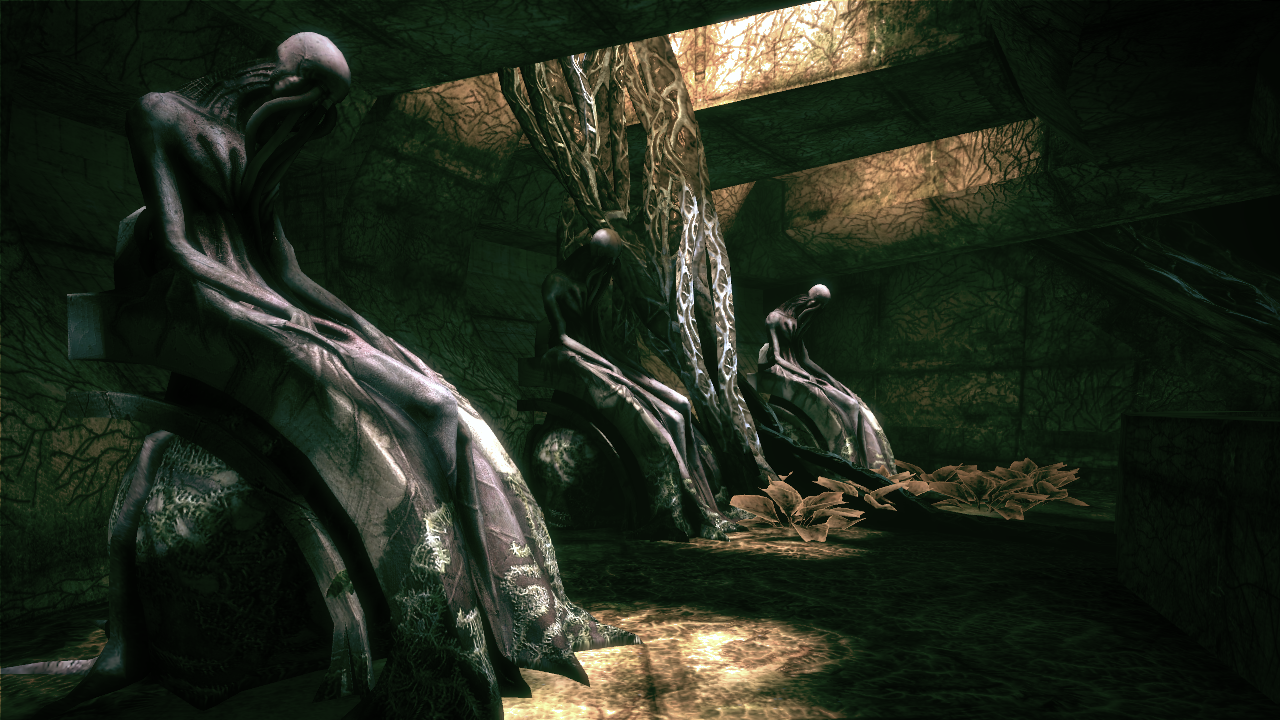
Image of Prothean statues on planet Ilos from ME1. (Click to enlarge.) Supposedly, a living Prothean actually makes an appearance in ME3 which has me really excited. It's difficult to see what they look like here, and the Collectors have altered the actual appearance of the Protheans.
Miranda Loyalty


There isn't a lot to say about this one, I don't think. There's the stuff about Miranda as a character, which is interesting. She is a genetically-modified human. Everything about her is made to be perfect, or as close to perfection as physically possible - even her appearance, as she herself points out. Technology assisted with making her so freakishly awesome, but she's very much a living being with flesh, blood, and personality. Not an organic robot. She has some serious baggage, though, about having no choice in the matter. Her father literally designed her to be this way. He's so narcissistic and egomaniacal that he used his own genetic material and combined it with whatever else he found that was the best of the best. She doesn't have a mom. (How sad!) She ran away from him once she had planned it out and was old enough to, and Cerberus scooped her up. She quickly rose in ranks and became one of the Illusive Man's best cohorts. Goody.


This mission is about Miranda's identical twin. Genetically, anyway, since her twin is actually several years younger. Miranda kidnapped her sister, Oriana, to save her from their father. She did it to protect her, since she understood the villainous ways of her father and wished to spare her from that life. You could compare her to the "silent angels" that euthanize dying patients in hospital wards, acting by the belief that they're helping others when perhaps they're not. (Free will, folks.) Did she have the right to do it? Maybe since she's actually a familial connection, there's more of a reason for her to be allowed to do it. And, of course, she experienced it herself and actually knows for a fact what her father is like. I'm on the fence about it. The situation warrants more merit than the typical trying-to-protect-my-sibling case. But I also never got to hear about the father's side of the situation, nor much about him as a guy beyond the fact that he's uber wealthy and successful in business. The whole concept of twins and genetics and whatnot is particularly relevant to me because I'm an identical twin. All those jokes and references and stuff made in society about twins is something I'm either fully aware of or have experienced in my two decades of life. I can attest to the fact that I'm absolutely not a clone, by the way, and that there are some pretty substantial differences between my sister and I. 


I'd really like to pick a bone with Bioware about potentially sexist programming with her character, how the camerawork specifically forces the gamer to "check her out" and accentuates her feminine aspects, but I'll bite my tongue for this blog. The game itself largely appeals to the young-adult male demographic, but I'm a college girl who loves these games. Then of course, you could argue whether they should do the same sort of sex appeal for male characters and if I would complain about that, which I very well might not, so... Ah, devil's advocate.


I love Yvonne Strahovski. She's a great actress, she's modest, she's gorgeous, and she's Australian. And all of this is coming from a straight woman.
Illium


A quick note about this planet. It's like a futuristic Seattle or New York City. The only place I visit as FemShep is Nos Astra, a marketing district to buy stuff. Pity, because this place would be awesome to explore. Well, I visit a couple of separate locations for the missions with Samara and Thane, but they're exclusive buildings that are nearby. This place is much less grungy than most of the planets visited. Clean, shiny, and - as well other places in the game - boxy. Synthetic stuff is to lines as organic stuff is to circles, if that makes sense. 


Pretty, no?
Recruiting Samara


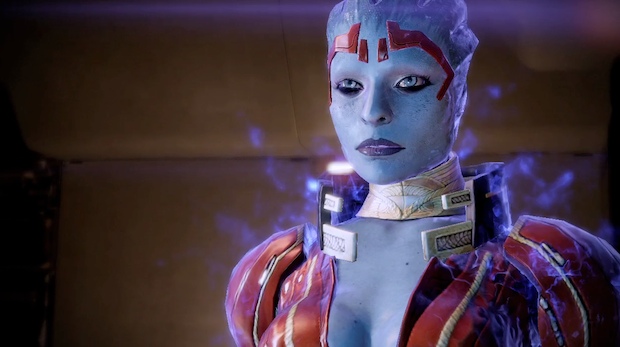
I believe a character in the game described her best: a warrior monk. She's an asari like Liara (who I'll come to in my next post) with wicked biotic abilities. (Hence the weird glowing purple stuff in the image below.) She's a justicar, a term in the game that refers to a small, powerful classification of asari who strictly follow a set of codes to uphold the law. They're similar to Spectres. The term "justicar" came from medieval England, and is used appropriately since justicars from our own timeline were judges who upheld justice. Good job, Bioware, for your historical accuracy. Asari justicars are selfless and lethal. They have a reputation for killing law-breakers ruthlessly and protecting the innocent to the death. If you're a criminal, you do absolutely everything in your power to steer clear of justicars or they'll getcha. They're a monastic order that follows a borderline religious code that covers pretty much any possible circumstance they could possibly face. They're governed by this code rather than living beings. In American society, the citizens are checked by the government, and the government is checked by the Constitution. The invariability lies in the fact that our court system can change the code with the laws and interpretations they pass. But I'd rather not delve into that ethical debate right now. Even so, I find Samara to be a fascinating character. 


Again, I'm biting my tongue over sexism here. Speaking plainly, Samara's boobs are ginormous and the outfit she wears certainly emphasizes that. Boing! As a character that vocally sounds like an older woman (and as a character who technically is an older woman), this could be a representation of the male audience that enjoys the appeal of "cougars". I could be making an interpretive leap here that isn't true, but...um. I have reason to believe it.


Video games are nothing but symbolic coding figured into computers to create technical images. How interesting that asari justicars abide by a strict code, when as far as I'm concerned, they're completely created by a technological code. 


Gaming Segment (7 Hours)


Free will keeps popping up in my mind with the ME series. It's much like the article I posted about ME3 where they actually do discuss how free will plays an important thematic role in the series:One of the series’ strongest themes is an exploration of what it means to be a living being. This ties very closely the concept of free will, and both ideas are defined by contrast to the Reapers. Reapers see other beings as material resources, and their most insidious trick is that before destroying organic life, they rob it of independence. In Mass Effect, the struggle to maintain control over oneself at all costs, even if it means dying in the process, is an important concept. This is further developed in Mass Effect 2, first in Jacob’s loyalty mission ( his father is discovered to have used the side effects of an indigenous plant to turn female coworkers into sex slaves as a means of survival), and with Legion’s, where it’s revealed that the Geth are actually a complex people who simply want the freedom to go their own way without fear of being destroyed. This creates a moral environment in which the crew of the Normandy isn’t just fighting to save Organic life from evil machines, they’re actually fighting for the right to exist on their own terms. 


It can't be ignored that a powerful concept that humans love to explore is free will. Look at the United States and our history of gaining independence. Look at our Bill of Rights and the First Amendment to the Constitution. Humans love freedom and frequently exercise their right to have it. It's no different, hypothetically, for any other competent species. Granted, we also love control and power, which creates a very interesting and conflicting dichotomy.

I'm enjoying this project immensely and am finding great intellectual satisfaction in it. I hope others can share my enthusiasm for it. Video games are awesome.

~Mel

Thursday, March 8, 2012

ME2 | Crime, Genetics, and Batman

To prove my love for this series, I give it big thumbs-up for replay value. At least half of the games I have I've only revisited maybe once, if ever. I've made tons of different Shepard characters and gameplays. I have a mix of both genders, Paragons, Renegades, Paragades, and Renagons. I think I've tried every class, background, status, etc. And I still have fun with it.


Recruiting Okeer/Grunt


The environment reminded me of a dying, torn-up corporation building or storage facility. It looked like a war zone, which is exactly what it was. Maybe not all of planet Korlus looks this way, but the area I went to is not remotely a hospitable vacation destination. I will say that it's an all-out trend for the ME series - the design of the landscapes. They all have those blocky, industrial, technologically-enhanced environments, but in different ways and to a different degree. I mean, this place had what looked like a bombed ship to make your way through. Sure, it had the cool slidey doors to open, but you could die just by walking too far any given way. Rooms without walls or guardrails. Freaky.


Okeer was developing mindless, genetically-bred fresh-from-the-test-tube Krogan soldiers. It's similar to before in ME1 with the test-tube Krogan Saren was creating, but not the same.


  • ME1 Krogan: controlled by Saren aka controlled by the Reapers; bred specifically to be used as Saren's army to help the Reapers kill everyone
  • ME2 Krogan: created by Okeer as a science experiment to make the perfect Krogan; imperfect experiments sent into battle field to be used as live bait for mercenary groups to shoot at or given to the Collectors for study
The situation is still rather unfortunate, since pretty much all of the test-tube Krogan die. (At least the ME1 Krogan were all killed at the same time and very quickly by a massive bomb. These Krogan get shot until they stop breathing.) The main similarity is that these Krogan can't think for themselves. They're created for a specific purpose that is out of their control. Are they really Krogan if they lack personalities and the ability to think for themselves? Would you say the same thing if we were talking about humans? The idea of chemically or genetically altering beings to make the perfect soldier isn't revolutionary for the past few years. Look at Captain America. He is the product of genetic engineering. (Ignore the fact that comic books tend to make things impossible, possible in a somewhat "magical" way. I think almost every main comic book character dies and comes back to life more than once.) Okeer was willing to give life to thousands of Krogan "rejects" and throw them to the wind to create the perfect Krogan that defies a genetic disease that's innate to all Krogan: the Genophage. It's basically a complicated genetic mutation that makes it difficult and sometimes deadly to give birth, which effectively controls the Krogan population. They're dangerous and powerful, especially in numbers, and after a galactic war with them... Well, a lot of aliens felt that keeping a cap on these guys would do the galaxy some good. Again, this is one of those areas where I understand what both sides (Paragon and Renegade) feel about this. It's like how society feels about abortion: most people are either pro-life or pro-choice and have good reasons for each. There actually are good reasons to limit the Krogan population, and the Genophage isn't the same thing as genocide. (I would recommend Googling or YouTubing what Mordin has to say about it, because his words are far more punctual and descriptive than my own.) If I didn't have an open mind, it would be very hard for me to understand this; I would be inclined to have a 100% Paragon attitude. But I am open-minded and can see why the Genophage, to a certain degree, makes sense. Okeer's experiment is "quality over quantity". He threw away hundreds of Krogan experiments - living experiments, no less - to ensure that at least one Krogan was ideal. Was it worth it? Maybe. That one Krogan - Grunt, who I became increasingly fond of and may even prefer over Wrex from the previous game - represents a rare and fascinating specimen of science. This brings up the nature v. technology thing again, though. He should be allowed to live his life without being used as an experiment, right? But shouldn't we be able to learn from his rare and potentially life-altering genetic code, especially if his genes could change life as all Krogan know it? (Put humans in place of Krogan if it's easier to consider that way.) 

Okeer (tanks with Krogan experiments behind him)
This mission also discusses legacy - the life you live and the life you leave behind when you die. It's a huge concept to all living things with the capacity for memory. (Goldfish have a memory capacity that lasts about ten seconds, so it's probably not a very big deal to them.) The evolution of technology and technical images have altered how we think of and how we view legacy. Facebook and all of the photos and statuses and such, when compiled, represent at least a portion of your legacy. Those photos and statuses could be stored on a digital format for hundreds of years and won't disintegrate like the time capsules of ye olden days. Also, consider the film industry. Cinema began in the late 1800's as a far more primitive form than what we're seeing today in 2012 with digital effects and 3D imaging software. For the folks who work with the media medium, their legacy largely involves making good films. James Cameron will forever be known for Titanic and Avatar. Even as someone who has barely begun my own life, I consider video games to be a part of my legacy as they have shaped how I think and view the world. I didn't make them, of course, but I've played them and manipulated them in my own ways, should the format allow it (meaning RPG's versus regular third-person, linear-action games). In some ways, we shouldn't feel so comfortable about this transformation, but in others we should be extremely grateful. (Insert argument from readers between paper and electronic novels.) 

I'll talk a little more about Grunt once I reach his loyalty mission, but it'll definitely come back to this stuff of legacy and genetic engineering. Poor dude was born in a tank. No personal attachment. Only memories and bits of genetic material sent through tubes and wires. 


Sidenote: Has anyone seen Gattaca? I can't help but recall the movie as I'm thinking about this concept of genetic mutation. Developing a science and technology relationship to a point where you can select specific attributes that you want in your child - as simple as creating an avatar character in a video game. What fun is there in life if everything is chosen for you?


Omega and Aria T'Loak


There is so much crime and gang activity on Omega. It's another not-so-happy place. I would never want to be anywhere on Omega alone. Anywhere. You could get jumped for no good reason. And everyone knows it. People - that is, the more innocent civilians who live in housing areas - pay a monthly fee to mercenary groups to protect them. Just like paying the bills. Crazy. I suppose it might work this way in foreign nations. I'm not well-informed with global politics. There's a good chance that some African tribes or the like do the same thing. And that is unfortunate indeed, when crime becomes the norm. (Then again, if it's the norm, what's so bad about it? Define normal.)


Planet Omega (I told you - it's built into an asteroid. AWESOME.)
It doesn't look that grimy, but trust me. It is. Miranda vocalizes her sentiments about it once.
Omega is where I found that blatant use of sexism. I was registering to help the mercenaries stop Archangel (I'll get to him in a minute). When the merc recruiter sees that FemShep is, well, a woman, he cops a snarky attitude and says something along the lines of, "The strippers are in another room". I wish the game had given me the option to pistol-whip him. Oh well. I probably killed him during the forthcoming mission anyway. Sweet vengeance. (Technically, I only killed a bunch of coded numbers, and didn't actually kill or shoot at anything. Thank you, technical images.)


Aria T'Loak is a neat character. A non-gamer told me that she looks a bit like Angelina Jolie. I don't see the resemblance, but I thought it was interesting enough to take a mental note of it. She's much like the Illusive Man or the Shadow Broker in that information and reputation are her main power sources. She can certainly kick someone's butt into the next century, based on the battle she had with the Patriarch (non-critical game detail, but interesting story), but she doesn't really have to use that kind of power anymore. And, of course, there's the sex appeal, which she unabashedly proclaims. Perhaps she's overconfident, but she runs all of Omega and, admittedly, does it well. I wish I could pinpoint it, but for some reason I trust her more than the Illusive Man.


Recruiting Archangel/Garrus


I didn't write much for notes on this part. (Well, to be honest, I didn't write anything at all, but I tend to remember things that I don't need to remember. Like movies, books and video games. Instead of more important things like history, politics, philosophy, and scholarly citations. Is there something to note that I remember things that interest me? Perhaps, but it's kind of common knowledge.) I found it to be one of the most tedious missions of the whole game, but maybe I'm just being picky. It's interesting that he became a Batman-like figure. A dark knight, if you will. The hero for the little people of Omega who takes care of the big bad wolves in a gesture of good faith. Garrus is one of my faves in regards to characters on a "Best bud" level more than a character development level, though he's good on both ends. I loved that he came back as a guy who turned around from a tragedy and kept helping people and kicking butt. I feel like he's more significant in ME1, though I certainly enjoyed having him on the team in this game. He's one mean dude with a sniper. His loyalty mission continues the Batman vibe where he toes the line between revenge and vengeance. One team member resulted in the death of his entire team, and he's (naturally) pissed. As a Renegade, FemShep easily lets Garrus kill him. Whatever it takes, eh? Also, it's no secret that I totally love that headpiece he wears. I've always found it so freakin' cool.


Horizon Mission


I'm not gonna go into great length about this part because it's mostly just a lot of shooting at the ugly Collectors. The big stuff with them that I'll probably take into consideration is at the end of the game when the real trouble goes down. Such a pity to learn that they're actually Protheans that have been extensively modified by the Reapers. (There seems to be a lot about genetic modification, eh?) This is one of the single-most frustrating parts of the game, even more so since I'm playing on a harder difficulty. I died twice, mostly because of those stupid husks that attack you at random. I can deal with the Collectors and Scions. All you have to do is duck beneath objects and sprint for a few seconds when they get too close.


Gaming Segment (4 Hours)


How do technical images me us feel so connected? (Haha. Punny.) Video games seem to do this more than any other technical medium. They're clearly not real, but they must be doing something right because of how people like myself become so immersed and invested in them.


I should talk about Miranda as a character. She very well might be one of my faves from the ME series. I have a sneaky suspicion that I'm biased, though. 1) I adore Australian accents. 2) Yvonne Strahovski portrays Miranda, who played Sarah Walker in one of my absolute favorite TV shows, Chuck. I'm still mourning its ending. 3) Her transformation is greater, in my opinion, than most of the other characters, especially in a Paragon route.


Speaking of character development, there's less of that on a Renegade mission. Not necessarily by a mile, but enough that it's noticable. Renegades simply don't take the time to get to know people and feel an emotional connection. If Renegade FemShep ever got the opportunity to settle down and raise a family, I don't think she would. She's a workaholic.


I honestly just want to power through the rest of the game and finish it. I'm on the cusp of the final battle. I just have to find Tali, explore that Collector ship and then after that, I can blast through the Omega 4 Relay and get down to business. (At that point, I'll have to figure out what I want to do with the final battle. Renegade Shepard is a little bit evil, but not stupid, so I probably won't make it into a suicide mission. Unless I'm persuaded otherwise.)


I'm Commander Shepard, and this is my favorite store on the Citadel. (That line is so annoying, it's funny. Renegade Shepard never uses it, though. FemShep simply DEMANDS the discount and gets it. Charm versus intimidation.)


~Mel