Search This Blog

Showing posts with label Mass Effect 3. Show all posts

Wednesday, March 14, 2012

ME2 | The Will to Act Freely, With or Against the Law

To continue my rampage over the ME3 ending, there is an excellent article that picks apart the ending of the game with specific reasons to feel disappointed. It justifies the fans' negative response in an eloquent manner. Worth reading, but be warned: there are massive spoilers, since it literally takes moments from the last ten minutes and exploits them. (I haven't played the game yet but was willing to be spoiled in order to understand why the ending certifiably sucks.) If you're not even a gamer, it's also worth reading. First of all, it furthers a point I've tried to make with this blog: gamers are people, too. Smart people, even. There is more to video games than staring at a television set for 12 hours, drooling, sweating, and getting calluses on your thumbs. Yes, sometimes that happens, but we put an intellectual and emotional (and, technically, physical) investment in these games that sometimes transcends that of any other medium. It's a very personal and exciting experience to play video games, especially RPG's, in my opinion. So, there. 


Garrus Loyalty


Have I mentioned that Garrus is also one of my favorite characters from the ME series? I don't really know why. I'll have to think about it. Perhaps I like him even more as a Renegade FemShep. I contemplated pursuing a relationship with him as my FemShep character, but didn't end up going there. (Actually, I didn't end up pursuing any romantic connections at all in this playthrough.) Perhaps it's because I can appreciate sarcasm, and Garrus definitely amps up the sarcasm.


Largely, this mission was about understanding the difference between vengeance and revenge. (The mission is even called "Eye for an Eye".) Garrus was effectively being a turian version of Batman who acted as an anonymous vigilante to wipe out crime syndicates and mercenaries. He gathered other strongarms who believed in his cause. One of those sidekicks, Sidonis, turned on him and caused his entire team to be murdered. Naturally, Garrus is seriously upset about it, dealing with a lot of guilt and anger. The mission (should you choose to accept it) is about helping Garrus to either kill the SOB or forgive and forget him. As a Renegade, I absolutely helped him with the killing. (Garrus is an excellent sniper, let me tell you.) 


I couldn't help but remember that scene from Batman Begins when Rachel Dawes is talking to Bruce after the trial for his parents' murderer. She points out that Bruce wanting to kill his parents' murderer is revenge, not vengeance.
Define "revenge": 
The action of inflicting hurt or harm on someone for a wrong suffered at their hands.
Define "vengeance":  Punishment inflicted or retribution exacted for an injury or wrong.
By the dictionary, there is no definitive difference between the two. Hence the confusion. I think a lot of the issue here is that revenge indicates pleasure or satisfaction with the act, whereas vengeance is supposed to be a form of justice that elicits no pleasure from the enforcer. Revenge is dehumanizing, but vengeance is morally acceptable. I find this interesting, since the dictionary claims that they're synonymous and society differentiates them by emotional empathy. One word changes whether or not you're morally reasonable. Is this a clever ploy created by some guy years ago to make murdering his dirty cheating wife justifiable?
This clip isn't the whole scene, and cuts out the dialogue that I'm referring to, but I always laugh when Rachel slaps him not once, but twice. This remix nearly made me erupt with laughter in the middle of a quiet library area. Oops.

(Quick sidenote: I've completed the Batman Begins video game for Gamecube a dozen times. I loved Batman, and it was the only real game I had at the time. There wasn't an Xbox or a Wii in my household then. And who doesn't want to be Batman at some point in their lives? I got to drive the Batmobile!)


Investigating a Collector Ship


Every time I do this level, it kinda freaks me out. This game isn't easy to play at night if I'm alone in my room, I admit it. The Collectors are creepy. It's the one area of the game where I take pleasure in blasting my guns. I loathe the husks with a fiery passion and enjoy watching those ugly, evil creatures fall to their deaths. The Collectors themselves are just below my feelings for husks, so I hate them, too. (After knowing things from the ending of this game and ME3, I don't hate them quite so much. All for the love of science and, in a twisted way, saving the galaxy. But I'll always hate the husks. They're almost an equivalent to zombies, except worse.) The danger of influence and science at its most extreme form is embodied by the Collectors themselves. (Again, nod to ME3 with the issue of organic versus synthetic.) The whole place is like a technological beehive. I don't like bees. It makes sense that the game makers did it this way, though, since the Collectors harvest species for study. They're meant to be like insects. 


Personally, I was pissed that the Illusive Man lured me into the ship. He planned the whole thing just so he could get some intel from the inside of a Collector ship. From the Renegade perspective, though, it made sense. Shepard makes impossible missions possible and has some of the best of the best crew members in the whole galaxy, so having confidence in FemShep's abilities is reasonable. Furthermore, the opportunity to learn about the Collectors from first-hand experience is rare and incredible. Their technology - which is technically Prothean and Reaper technology - is very advanced. To be able to study that would be amazing and could help out humanity as well as other species. (In other words, it's a very dangerous thing to put into the Illusive Man's hands as a Paragon, but a very good and innovative thing to give him as a Renegade.)


FemShep spoke with Mordin after the mission. (He's the voice of reason in all of this chaos, which is interestingly contrasted with the difficulty of following his speech pattern.) The Collectors are not Protheans, or even descendants of Protheans. They are clones of Protheans. Their genetic and organic material was studied, taken apart, and put back together with modifications to create the Collectors, a race purely designed by the Reapers to collect species, study them, and probably do the exact same thing. (ME3 answers this, I think.) They have no culture or personality - nothing that gives them any sense of individuality.  Culture and art, as Mordin points out, represent a philosophical and intellectual progression in some form. Advancement in society is dangerous at opposite ends of the spectrum; if there is no progression when society is ready for it, or progression when society is not ready for it, bad things happen. There must be a balance where a step forward in culture occurs when the people are prepared for it. As time changes, society changes. The Collectors have no society to be changed, and time makes no difference to them. This proves their synthetic connection - the part of them that is technologically altered by the Reapers. They're organic robots. It's an awesome and terrifying idea. 
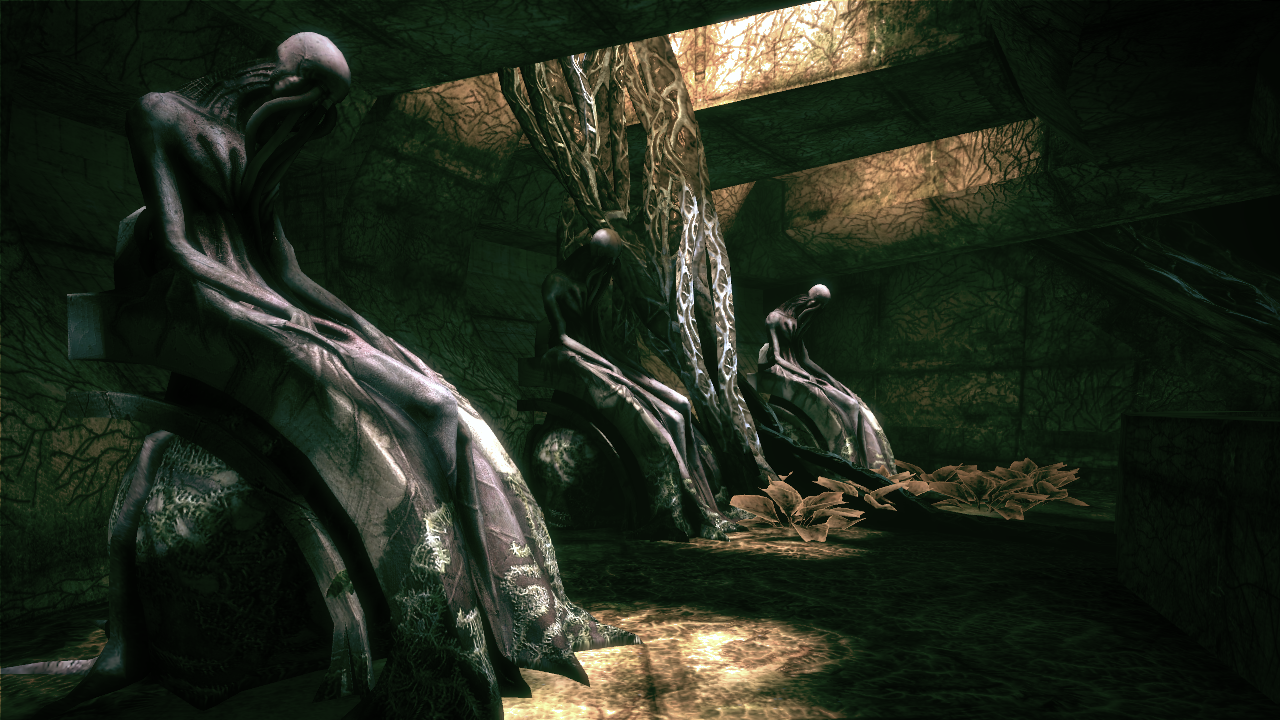

Image of Prothean statues on planet Ilos from ME1. (Click to enlarge.) Supposedly, a living Prothean actually makes an appearance in ME3 which has me really excited. It's difficult to see what they look like here, and the Collectors have altered the actual appearance of the Protheans.
Miranda Loyalty


There isn't a lot to say about this one, I don't think. There's the stuff about Miranda as a character, which is interesting. She is a genetically-modified human. Everything about her is made to be perfect, or as close to perfection as physically possible - even her appearance, as she herself points out. Technology assisted with making her so freakishly awesome, but she's very much a living being with flesh, blood, and personality. Not an organic robot. She has some serious baggage, though, about having no choice in the matter. Her father literally designed her to be this way. He's so narcissistic and egomaniacal that he used his own genetic material and combined it with whatever else he found that was the best of the best. She doesn't have a mom. (How sad!) She ran away from him once she had planned it out and was old enough to, and Cerberus scooped her up. She quickly rose in ranks and became one of the Illusive Man's best cohorts. Goody.


This mission is about Miranda's identical twin. Genetically, anyway, since her twin is actually several years younger. Miranda kidnapped her sister, Oriana, to save her from their father. She did it to protect her, since she understood the villainous ways of her father and wished to spare her from that life. You could compare her to the "silent angels" that euthanize dying patients in hospital wards, acting by the belief that they're helping others when perhaps they're not. (Free will, folks.) Did she have the right to do it? Maybe since she's actually a familial connection, there's more of a reason for her to be allowed to do it. And, of course, she experienced it herself and actually knows for a fact what her father is like. I'm on the fence about it. The situation warrants more merit than the typical trying-to-protect-my-sibling case. But I also never got to hear about the father's side of the situation, nor much about him as a guy beyond the fact that he's uber wealthy and successful in business. The whole concept of twins and genetics and whatnot is particularly relevant to me because I'm an identical twin. All those jokes and references and stuff made in society about twins is something I'm either fully aware of or have experienced in my two decades of life. I can attest to the fact that I'm absolutely not a clone, by the way, and that there are some pretty substantial differences between my sister and I. 


I'd really like to pick a bone with Bioware about potentially sexist programming with her character, how the camerawork specifically forces the gamer to "check her out" and accentuates her feminine aspects, but I'll bite my tongue for this blog. The game itself largely appeals to the young-adult male demographic, but I'm a college girl who loves these games. Then of course, you could argue whether they should do the same sort of sex appeal for male characters and if I would complain about that, which I very well might not, so... Ah, devil's advocate.


I love Yvonne Strahovski. She's a great actress, she's modest, she's gorgeous, and she's Australian. And all of this is coming from a straight woman.
Illium


A quick note about this planet. It's like a futuristic Seattle or New York City. The only place I visit as FemShep is Nos Astra, a marketing district to buy stuff. Pity, because this place would be awesome to explore. Well, I visit a couple of separate locations for the missions with Samara and Thane, but they're exclusive buildings that are nearby. This place is much less grungy than most of the planets visited. Clean, shiny, and - as well other places in the game - boxy. Synthetic stuff is to lines as organic stuff is to circles, if that makes sense. 


Pretty, no?
Recruiting Samara


I believe a character in the game described her best: a warrior monk. She's an asari like Liara (who I'll come to in my next post) with wicked biotic abilities. (Hence the weird glowing purple stuff in the image below.) She's a justicar, a term in the game that refers to a small, powerful classification of asari who strictly follow a set of codes to uphold the law. They're similar to Spectres. The term "justicar" came from medieval England, and is used appropriately since justicars from our own timeline were judges who upheld justice. Good job, Bioware, for your historical accuracy. Asari justicars are selfless and lethal. They have a reputation for killing law-breakers ruthlessly and protecting the innocent to the death. If you're a criminal, you do absolutely everything in your power to steer clear of justicars or they'll getcha. They're a monastic order that follows a borderline religious code that covers pretty much any possible circumstance they could possibly face. They're governed by this code rather than living beings. In American society, the citizens are checked by the government, and the government is checked by the Constitution. The invariability lies in the fact that our court system can change the code with the laws and interpretations they pass. But I'd rather not delve into that ethical debate right now. Even so, I find Samara to be a fascinating character. 
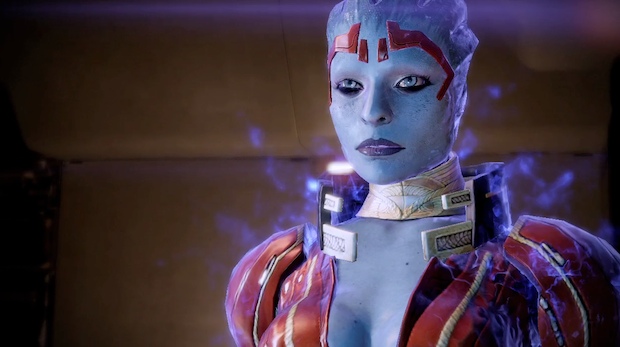


Again, I'm biting my tongue over sexism here. Speaking plainly, Samara's boobs are ginormous and the outfit she wears certainly emphasizes that. Boing! As a character that vocally sounds like an older woman (and as a character who technically is an older woman), this could be a representation of the male audience that enjoys the appeal of "cougars". I could be making an interpretive leap here that isn't true, but...um. I have reason to believe it.


Video games are nothing but symbolic coding figured into computers to create technical images. How interesting that asari justicars abide by a strict code, when as far as I'm concerned, they're completely created by a technological code. 


Gaming Segment (7 Hours)


Free will keeps popping up in my mind with the ME series. It's much like the article I posted about ME3 where they actually do discuss how free will plays an important thematic role in the series:One of the series’ strongest themes is an exploration of what it means to be a living being. This ties very closely the concept of free will, and both ideas are defined by contrast to the Reapers. Reapers see other beings as material resources, and their most insidious trick is that before destroying organic life, they rob it of independence. In Mass Effect, the struggle to maintain control over oneself at all costs, even if it means dying in the process, is an important concept. This is further developed in Mass Effect 2, first in Jacob’s loyalty mission ( his father is discovered to have used the side effects of an indigenous plant to turn female coworkers into sex slaves as a means of survival), and with Legion’s, where it’s revealed that the Geth are actually a complex people who simply want the freedom to go their own way without fear of being destroyed. This creates a moral environment in which the crew of the Normandy isn’t just fighting to save Organic life from evil machines, they’re actually fighting for the right to exist on their own terms. 


It can't be ignored that a powerful concept that humans love to explore is free will. Look at the United States and our history of gaining independence. Look at our Bill of Rights and the First Amendment to the Constitution. Humans love freedom and frequently exercise their right to have it. It's no different, hypothetically, for any other competent species. Granted, we also love control and power, which creates a very interesting and conflicting dichotomy.

I'm enjoying this project immensely and am finding great intellectual satisfaction in it. I hope others can share my enthusiasm for it. Video games are awesome.

~Mel

Tuesday, March 13, 2012

ME2 | Humans Playing God, Science, and Identity

As I play, I'm finding myself increasingly justifying the actions of a Renegade character. That, or maybe I'm simply understanding it more now that I've actually taken the time to consider it. The experience certainly proves that I'm no exception to the overall ignorance of humanity as a whole. Perhaps Renegade FemShep isn't as bad as she seems. The poor image of her is tainted by her tendency to swear and make brash decisions when in reality, obscenities are just words and her choices are very logical with a focus on how it will effect everyone in the future. The Renegade character is always looking forward in time and with a mindset that covers the big picture rather than the here-and-now that the Paragon seems to see. 


I just recently discovered how Mass Effect 3 ends, and I must say that I'm disappointed. I'm entering the realm of spoilers here, so avert your gaze until you see bold lettering if you wish to play it with a fresh eye. 
The adventures and missions embarked upon throughout the first two games of the ME trilogy foreshadow an epic, ridiculously awesome and difficult showdown with a huge, astronomically powerful alien race that plans to annihilate the galaxy. While the revelations about the Reapers and what their true intentions are seem interesting to me - I'm basing all of my information about ME3 by quick glances of reviews online - it's the ending that seems to have everyone in an uproar, including myself. It's a bit extreme to claim that everything you do up to the final moments is for nothing. Billions of beings' lives are saved by Shepard's efforts, and he is given somewhat of a godlike status for his actions. But a big part of what made this RPG so satisfying is that you, the player, have a ton of control over how the game plays out. Bioware hyped up this game and said that decisions had an even greater impact on the overall outcome of the game than ever before. Yet the ending resolution to the game ultimately ends the same way, no matter what choices you make: 1) Every mass relay is destroyed, leaving several and almost all of the galaxy's life forms stranded on foreign planets with zero contact to other species and a high probability of dying there. 2) Shepard dies. There's no avoiding it at all. Supposedly, if you have a high enough amount of XP you can see Shepard twitch right before the credits, clinging to life but ultimately losing the battle. 3) Your crew gets spaced, too. All of those characters you learned to love or hate, but appreciate and respect nonetheless, die in vain. Now, I have to play devil's advocate with this, as someone who is viewing this gaming series with a critical eye. Not everything in life has a happy ending. With something as huge, dramatic, and violent as this is, it's reasonable that there will be a lot of death and some seriously depressing results. But what many gamers who became invested in this series had hoped to see was the impossible: Shepard lives, has a happy ending with his or her LI (love interest), has drinks with the crew, and pans back to a view of the galaxy, which has taken a hit but is working on rebuilding itself. It's all too possible and realistic that the galaxy would be destroyed, almost everyone dies, and the Reapers essentially accomplish what they were aiming for. It's a bit surprising to me that Bioware chose to end the series this way, and, as I said before, disappointing. There's already a movement to get Bioware to create a DLC to "fix" the ending and allow gamers the choice to save more lives, prevent the mass relays from being destroyed, and not die. I, for one, am all for it and hope their efforts succeed. Technical images are most satisfactory when we have control over them, as I have likely shown through my gaming journey here. When the ending was taken out of our control and destruction and death became the only solution, we threw our controllers into the air with disgust. I'm not nearly as excited to play ME3 now. Had I heard that there was a possibility to save the galaxy and have that "only in the technical realm" happy ending, I would still be stoked to play, even with the spoilers. Here's to hoping.


Okay. Now to the stuff I actually did in ME2. 


Jack Loyalty


There's an undeniable resemblance to Grunt with Jack. She, too, was tested by her own race to create the perfect biotic soldier. Many people died in pursuit of exploiting her abilities. The difference here is that the truth was hidden from her. There are so many things she never knew as the process continued. She was experimented on - tortured, really, because she felt a lot of pain on both a physical and psychological level - as a child. It was only through the Shadow Broker DLC that I learned a teeny bit more about Cerberus' motives with her. (It also made me hate Cerberus a bit more than I already do. They're dangerous extremists.) She was exposed to Element Zero, as other biotics had been, but she had been given a dangerous amount of it and, amazingly, survived. Cerberus lied to Jack's parents, who know nothing of Jack's whereabouts, and kidnapped her to be used as a labrat. She was dumped in with kids that had been purchased as slaves or stolen by pirates. The loyalty mission itself is to destroy the facility that kept her imprisoned. Literally. She wants to blow it up, and we do by the end of the mission. (I'm getting a slight vibe from The Count of Monte Cristo here. Deception, isolation, truth, and revenge - in that order - puts Edmond Dantes and Jacqueline Nought in a similar circumstance. I like that I found out her real name, too. I knew it wasn't simply Jack.) Her tough and sexual exterior are a response to her life in what seemed to her as a prison. This level also showed some of Jack's humanity - her soft side, if you will. She isn't just some obscene wild woman or rebel without a cause. She very much has cause. Cerberus stripped her of a normal life and made her what she is today. (Again, Monte Cristo much?) Granted, the choices she made after she escaped were her own and it can be argued of whether or not she could still make them, but that would be a purely hypothetical argument about a technical image, so you wouldn't really get anywhere with that. She said something along the lines of, "I believe that horrible things or actions must have a good reason". Under her hard outer shell, she has a reasoning and moral center that tries to find the good in the bad. For the most part, she's had great difficulty with this, which has led her to be frustrated and full of despair, as well as distrusting of everyone. 


Pragia (testing facility where Jack was held)
This makes me ask the question: What limits corporations with revolutionary scientific study? How far should they be allowed to go with their research? This again reminds me of Makers by Doctorow, and of Gamer starring Gerard Butler. It's a game of money and power. Life is a game of money and power - to some, anyway. Where is the end to all of this? Does the end of the game of power (a la A Game of Thrones) mean an end to all of civilization as we know it? Perhaps the Reapers were on to something. (See ME3 spoilers for details on what I mean by that.)


Mordin Loyalty


As much of the game has hinted at, Mordin's loyalty mission bears a connection to his previous work on the Genophage as a member of the STG. It weighs on his conscience greatly as he struggles with whether or not it was the right decision to make - whether he should have made the decision in the first place. (How interesting. To a certain degree, he represents human's struggle with the concept of power and the consequences that can come with playing god.) It also showed Mordin's scientific philosophies. He strongly values all life and would rather preserve it than kill an innocent being for research. (My hero.) He would never perform experiments on live test subjects, and limited subjects by their intelligence level. If they're "capable of calculus", he refused to work on them. Human scientists of today likely perform their studies similarly. Rats and mice are common test subjects. They're living creatures, as many pro-life animal supports will adamantly point out, but they lack the higher intellectual capabilities that humans are capable of (amongst other creatures that also have higher mental capacities). ME2 emphasizes how fascinating the human race is, and this level plays on that factor. Humans are shown to have been studied upon, valued for their "diversity". The game makers made it so that all other species are strikingly similar to one another whereas humans and their (or should I say, our) genetics have such a wide range. Mordin knows that "all life is precious" and is vehemently opposed to his former allies' efforts to restore the cure to the Genophage - not because curing the Genophage is necessarily bad, but because his fellow salarian's methods at achieving it were less than reputable. 


Tuchanka (a giant dump that Krogans live on)
Speaking of life forms, I made a note of how intelligence can be a burden on living beings, but such a burden has no presence in the form of technology. This computer that I'm typing on doesn't have morals or feelings of its own. (Or does it?...) It's a logical output of words, images, and symbols that were input by beings with morals and feelings. If I used scraps of technology, just like Perry and Lester from Makers, and made a robot, and then I commanded it to kill my lab partner, the burden of guilt and remorse will be put on me. The computer will be the logical factor that reminds me that his circuitry wasn't completed yet and without said lab partner, I can't finish it. Technology lacks the "human" trait of compassion and general feeling. Of course, it also lacks such things as flesh and blood, too.


And this brings me to the Reapers themselves, who are a combination of organic and synthetic material. ME2 hints at this in the final battle of the game. Reapers are made of organic material - humans, for example - and technology helps to support their size and the fact that they're also spaceships. It's honestly pretty difficult to wrap my head around. Consider it this way. Think about yourself and your body. You are an organic, living being, filled with anatomical parts that fulfill bodily functions. Now imagine that you're two or three as big as you are now, thanks to a technological experiment that hooked you up with wires and electronic parts. You have all the same internal organs and stuff, but there's now additional room to, say, store stuff. Maybe your cat can sleep in your chest cavity. The Reapers are like that. They're giant, semi-living creatures that have been heavily supported by a futuristic form of technology to make them live the dual identity of a creature and a ship. ME3 enforces this further with the final choices. (Sorry, guys. I'm a spoilery person, when it comes to games and TV shows. Can't help it.) And, as a sci-fi fan, I would be inept if I didn't mention Moya, the ship from Farscape that is, as Crichton mentions in the intro, "a living ship". 


This diagram points out the fact that Moya is both a spaceship with a docking bay and a living creatures with a brain.


Grunt Loyalty


I didn't take too much down for Grunt's mission, as it was also on Tuchanka and I just wanted to get it over with. It's mainly about seeking a personal and cultural identity. He feels torn as a Krogan who was created in a test tube - one who cost many potentially strong (both in physique and willpower) Krogan their lives - and whether or not he deserves to be part of the Krogan society on Tuchanka. As a true Krogan, which he technically is, he needs to be a part of their world. (Cue the accidental song lyrics reference to The Little Mermaid.) That's something the game makers took an interesting take on. Krogan have a biological need to satisfy their place in society, similar to what humans would call "puberty". (Jack points this out in that oh-so-sarcastic manner she embodies.) This mission centers on something all people must experience at some point in their lives, usually during the time between their mid-teens and mid-twenties. We must all have an understanding of who we are as individuals and where we stand in society. Self identity and cultural identity. One more point that I made a note of is emphasis on "krant", or comrades. As the Beatles famously sang, "I get by with a little help from my friends". At the risk of sounding corny with this cliche, the power of friendship is something that shouldn't be underestimated. Humans innately rely on a physical, intellectual, and emotional connection with others. In the Mass Effect universe, that same policy applies to all species with the "higher intellectual capacity" that Mordin elucidates.

A thresher maw, as previously shown in ME1. This thing is massive in size, and also a big pain in the butt. When I first played the game, it scared the crap outta me. 
Gaming Segment (3.5 Hours)


One note I made reminded me of the television shows Bones and Sherlock. The titular characters, Temperance Brennan and Sherlock Holmes, are extremely brilliant but lack proper social skills. They're very honest and have a logical, scientific mind that deviates from traditional human compassion. Renegade FemShep strikes me as someone who fits into this group, but with a little more firepower involved. She's certainly not stupid, but also definitely won't go out of her way to shake hands with a fan or get to know a fellow soldier. She's driven by the job. Get from Point A to Point B in the most efficient way possible. End of story. 


While there's nothing that can be done now, had I been able to do so, I would have liked to play a game I had never played before. It would have been annoying to have to stop and take notes on something I'm completely unfamiliar with, but it would have seemed less forced. On the flip side, there are advantages to knowing what's going to happen, beyond the obvious factor of no surprises. I can afford to gloss over things I know are insignificant and focus on immersing myself intellectually into previously unexplored areas. Pros and cons in everything, eh?


Only a few more posts to go! The end is in sight! I will say, though, that this experience will likely remain with me in the sense that I'll continue to play video games with a critical judgment. Similar to my film class and the theorist Barthes, I'll divide my mentality into half-immersive gamer that totally digs all the visual stuff, and half-intellectual gamer that sees beyond the image to why it's there, what it represents, etc. And that's fine with me. I might have better gaming experiences this way.


~Mel